Sunday, October 22, 2006

Smithsonian's National Museum of the American Indian Celebrates American Indian and Alaska Native Heritage Month

Smithsonian's National Museum of the American Indian Celebrates American Indian and Alaska Native Heritage Month

Contact: Amy Drapeau, 202-633-6614 or drapeaua@si.edu; Leonda Levchuk, 202-633-6613 or levchukl@si.edu, both of the Smithsonian Institution; Public only: 202-633-1000

WASHINGTON, Oct. 10 /U.S. Newswire/ -- To celebrate American Indian and Alaska Native Heritage Month in November, the Smithsonian's National Museum of the American Indian in Washington, D.C., will host a variety of free public programs.

Panel Discussion: On Friday, Nov. 3, at 7 p.m. in the Rasmuson Theater, a panel discussion will be held on "Indigenous Archaeology: Respecting Objects, History and Place."

Dance Performance: The Lepquinm Gumilgit Gogoadim (Our Own Dance in Our Hearts) Dance Group from Alaska, will present heritage songs and dances from the Tsimshian culture Friday, Nov. 3 through Sunday, Nov. 5, at 10:30 a.m. and noon in the Rasmuson Theater.

Storytelling: Hope and Company, led by Ishmael Hope (Inupiaq/Tlingit) and storytellers, will share stories about Alaska Native heritage Tuesday, Nov. 7 through Thursday, Nov. 9 and Saturday, Nov. 11 and Sunday, Nov. 12, at 2 and 3:30 p.m. in the Rasmuson Theater.

Art Demonstration: David Boxley (Tsimshian) will demonstrate the art of wood carving from Friday, Nov. 10 through Sunday, Nov. 12 at 11 a.m., 1 and 3 p.m. in the Potomac Atrium.

Family Day: A Family Day program on "North Pacific Coast Weaving Traditions" will take place Saturday, Nov. 11, from 10:30 a.m. to 3 p.m. in the Education Workshop on the third level. Tlingit weaver Lorene Boxley will talk about Tlingit women's weaving and participants will have an opportunity to create their own mat or basket to take home.

Performance: Tobias Vanderhoop (Aquinnah Wampanoag) will present "A Wampanoag Thanksgiving" Tuesday, Nov. 14 through Thursday, Nov. 16, at 10:30 a.m., 1 and 3 p.m. in the Rasmuson Theater. Through story, song, drumming and dance, visitors will learn how Wampanoags traditionally offered thanks before contact with non- Natives.

Film: "Stolen Spirits of Haida Gwaii" will be screened in the Rasmuson Theater Friday, Nov. 24, at 7 p.m. and Saturday, Nov. 25, at 1:30 p.m.

All programs are subject to change, for a complete schedule of public programs, visit http://www.AmericanIndian.si.edu .

Sunday, October 15, 2006

Native American Artist's web sites

In a recent survey, Southwestern Association for Indian Arts (SWAIA) determined that fewer than 25% of the artists surveyed have their own web site, although more than 50% use a computer in one way or another.

Frankly, we support the concept of Native American artist web sites. Just as we support Indian Market as an opportunity for artists to get full retail prices for their work.

As someone who has built and maintains web sites, however, I know it is not a part-time job. In my opinion, the artists' time will be more productively spent doing what they do best and love to do; creating art.

Fortunately for the artists and for the customers who love their creations, there are web sites like these (Native-JewelryLink.com, ZuniLink.com, Native-PotteryLink.com and TribalWorks.com) to provide an outlet and a medium for the acquisition of the art production.

By the way, while we understand some dealers operate on a consignment basis, we do not. We pay cash for every item we purchase, providing the artists with steady and assured income for their efforts. The artists could eventually get somewhat more for their work under the consignment system. But they almost certainly will have to wait until it is resold to realize any cash flow. And cash flow is what puts food in the cupboard and supplies on the worktable.

That's why we like to do business the way we do.

SWAIA sponsoring an Indian Market Winter Showcase

Southwestern Association for Indian Arts (SWAIA) has annoucned that a Winter Showcase will be held on Thanksgiving weekend in Santa Fe.

A special "early bird" session will be held on Friday, November 24, from 5 PM to 8 PM. with 100 artists' booths available for buyers willing to pay a $50 admission fee to purchase before the full event on Saturday, November 25. Admission will include a wine bar and hors d'oeuvres.

Saturday's event will open at 9 AM and continue until 4 PM with a $5 admission fee.

All events will be at the Inn and Spa at Loretta, downtown Santa Fe. For more information, visit SWAIA.org .

By the way, the 86th Annual SWAIA Santa Fe Indian Market will be held on August 18 and 19. Based on occupancy rates at previous Indian Markets, it's not too soon to get your hotel reservations in.

It's all about trust...and return privileges.

We know that there is a difference between buying something in person, where you can hold it and make sure it is what you want, and buying on the basis of a photo and some words you read on the internet.

Whenever you buy from an Aboriginals Gallery web site (ZuniLink.com, TribalWorks.com, Native-PotteryLink.com and Native-JewelryLink.com), you have 10 days from receipt of the order to evaluate it and determine that it is what you thought it would be. If you are unhappy with your purchase and you let us know with 10 days and you return the item in its original condition, we will refund 100% of your purchase price. Shipping costs will be your responsibility.

If the item is being purchased as a Chrismas gift, we will honor the return privilege for seven days after the December 25th.


If you miss the cut-off date for full refund, we still will provide a credit equal to the amount of your purchase price on any other item on any of our sites, as long as the item is returned within a reasonable period in original condition.

We also offer a 30-day authentication privilege for certain purchases.


If, within 30 days, some recognized third-party authority challenges the authenticity of the item and disputes that it is not what we advertised it to be, you may return it for a full refund of your purchase price. We only ask that you provide the name and contact information of the authority so that we can determine what has been mis-identified and what he or she feels is the proper identification.

In 25 years of trading in tribal art, we have had one item returned for a dispute over its authenticity. We honored our refund pledge. We have had less than a dozen of the hundreds of items purchased from us returned for reasons of dissatisfaction. In every case, we either refunded the purchase price or provided a full value merchandise credit.

It's all about trust.

Glass with class

Recently, some Native American artists have begun to work in hand-blown art glass.

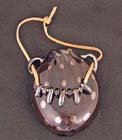
We recently acquired a work by Ira Lujan of the Taos Pueblo that is stunning in its artistry. Here is a thumbnail photo of it.

Clicking on the thumbnail will take you to a page with a larger photo, dimensions and price.

Please note that the canteen has a leather strap suspending matching glass amulets for a beautiful display when hung on a wall.

We hope to see and acquire more of Ira's work in the future.


If you would like to acquire this one for your collection, it is available as of this posting.

Lynn & Jayne Quam favorites

We have yet to meet a Zuni carver for which we don't have the highest respect and admiration. Lynn & Jayne Quam, however, are among our favorites. Lynn is Zuni and Jayne, his wife, is Navajo/Zuni by virtue of marriage. They live on the Zuni Pueblo and have had us into their home on several occasions.

Lynn is well-known for his buffalos, although he also does inspired bears as well. Here's one of his latest buffalo carvings, in mother of pearl. If you click on the thumbnail here, you will go to a larger photo, with dimensions, price and a link back to his page to see more of his outstanding work.

Jayne is equally well-known for her wolf and fox pairs and family carvings. Here is one of her latest.
Again, click on the thumbnail photo to go to a larger picture with dimensions and pricing. We get many request for her pairs from people who want to give them as unique gifts to couples who are getting married or are expecting a family addition.

Lynn and Jayne are proof that you can be very talented and very nice too.

~~~~~~~~~~~~~~~
Tribal Artery is the periodic blog from Aboriginals: Art of the First Person and its allied websites at Native-JewelryLink, Native-PotteryLink.com, Tribalworks.com and ZuniLink.com. You are invited to visit them. Thank you.

Now, it's OUR nickel.

"Finally," some would say, we have acquired a toll-free 800# for people who want to inquire about an item being offered or to actually place an order.

Up till now we have not felt the need for one or suspected that not having one would stand between a potential buyer and the object of his or her affection.

Some recent research, however, has led us to believe that an 800#, whether worth the cost or not, is a form of respect for our customers that we should be providing.

So now we have one - 800-305-0185.

Write it down or load it into your cellphone directory.

You can call us and it won't cost you an extra penny.

It's about time, I guess.

Do you agree? Will an 800# make you more likely to call? Why not post a comment to this blog with your reaction.

Or call us. It's toll-free at 800-305-0185.

~~~~~~~~~~~~~~~~~~~~~~~~~

Tribal Artery is the periodic blog of Aboriginals: Art of the First Person and our online galleries at Native Jewelry Link, Native Pottery Link, TribalWorks and ZuniLink. Thanks for visiting our blog. Let us know if you find it interesting and/or informative.

Friday, October 13, 2006

Hopi-Navajo Nations find common ground

The Santa Fe New Mexican reports that the Navajo and Hopi tribes have settled a dispute over the use of reservation lands that has soured relationships between the two people for decades.


In 1966, the Federal Government banned any new consruction on the disputed lands, including even roof and plumbing repairs. 700,000 acres of Navajo land claimed as aboriginal lands by the Hopi were in dispute.

The Hopi Tribal Council voted 18-0 to approve an intergovernmental agreement that had previously been approved by the Navajo Nation Council.

The agreement will allow both the Hopi people and the Navajo people to use adjoining lands for traditional religious purposes without approval from the other tribe.

For more information go to http://www.freenewmexican.com/news/50587.html.

New folk art pottery posted

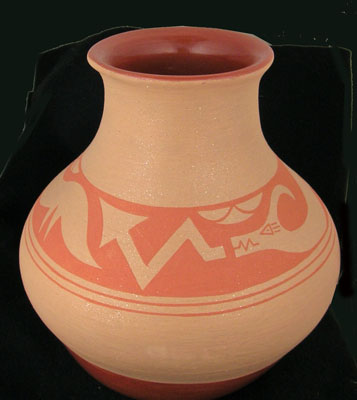
Tribalworks, the folk art web site of Aboriginals: Art of the First Person, has just had a handful of new pottery folk art animals from Navajo, Larry Benn, posted to its Navajo Gallery.

Here are some thumbnails.

Click on anyone of them to go to the page that will give you more detail.

This is a relatively new medium for Native American folk arts. We have seen several pieces of varied theme and size. These animals, however, struck us as particularly charming.

Needless to say, each is a unique one-off and duplicates are not available. So, if you see one you want, it would be wise to order now.

~~~~~~~~~~~~~~~~~~~~~~~~~

Tribal Artery is the periodic blog of Aboriginals: Art of the First Person and our online galleries at Native Jewelry Link, Native Pottery Link, TribalWorks and ZuniLink. Thanks for visiting our blog. Let us know if you find it interesting and/or informative.

Sunday, October 08, 2006

Three vintage Native American pots go to new homes.

Aboriginals Gallery recently sold three pots featured on its Native-PotteryLink.com site to collectors of vintage Native American pottery.

One of them was a canteen-style, corrugated-finish by pot by the late Stella Shutiva of Acoma Pueblo. A second one was a nice older olla by Nambe artist, Lonnie Vigil.

The third was a past Indian Market prize winner by Christine McHorse, Navajo.

Each of these vintage pots was available at a bargain price simply because we acquired them several years ago and never raised the selling price to replacement value.

Stella Shutiva is deceased. Lonnie Vigil’s reputation has grown over the years so that his work now earns much higher prices than we paid a few years ago. Christine McHorse has abandoned making pottery in favor of creating bronzes.

If you are so inclined, give the site a look-over for some vintage treasure at prices from the past that may be waiting there for you.

~~~~~~~~~~~~~~~~~~~~~~~~~~~~

Tribal Artery is the periodic blog of Aboriginals: Art of the First Person and our online galleries at Native Jewelry Link, Native Pottery Link, TribalWorks and ZuniLink. Thanks for visiting our blog. Let us know if you find it interesting and/or informative.

Surfing for the good stuff

If you are like me, you are prone to distraction while on the web. I chalk it up to the peril of an active mind. (grin)

Anyway, I start down one digital path looking for something specific and a run across something related that I can’t pass by without a click.

“Whoops! There he goes”, says Susanne.

Suddenly I’m looking at stuff I didn’t intend to search for but that is absolutely captivating.

Two recent web sites that I came across may be of interest to you so I will share the links here. One is the Douglas Society at the Denver Museum. It’s powerhouse of tribal art information. The address is www.douglassociety.com.

A second site is the California Academy of Science in San Francisco. You don’t have to go to the City by the Golden Gate to share one of the most impressive sites – both graphically and for content – that I have ever come across. The address is www.calacademy.org. Click through to research/library/elkus for a fascinating sortie into the papers of this major collector of Southwest Indian art.

Incidentally, both sites have spectacular online newsletters.

When you find sites like these, you might want to put them in your “favorites” folder for future reference. We’ve found that there is so much to see and consider on the web that it is easy to get lost and not know where you saw something or someplace you want to return. Your “favorites” folder is a good place to “file” these sites so you can find them easily.

We assume you already put our sites in that folder. (grin)

~~~~~~~~~~~~~~~~~~~~~~~~~~~~~~

Tribal Artery is the periodic blog of Aboriginals: Art of the First Person and our online galleries at Native Jewelry Link, Native Pottery Link, TribalWorks and ZuniLink. You are cordially invited to visit the sites and see what is new.

We love feedback.

Our favorite form of feedback is an actual order or a question about one of the art objects we offer.

Second is from folks who email us to tell us how much they like our web sites.

But other feedback can be even more important.

After a recent wall-to-wall redesign of our site at www.Native-PotteryLink.com, we solicited review and feedback from some of our friends and readers.

One of those people contacted us to say that they had found a broken link on the site. Sure enough. Even more important, when we went in to fix it, we found a couple of pages that we thought we had updated but had not. So we fixed those too.

So our thanks go to Rand at RandAfricanArt.com for setting us on a voyage of improvement. Incidentally, Rand’s site is one of the most informative you will find on the web on the subject of African tribal art. If you can’t find what you are looking for on our African tribal art pages at tribalworks.com, we recommend a visit to Rand’s site to see what he has. Heck, we don’t mind if you visit his place first and then visit ours. The most important thing is to find what you are looking for, regardless of where you find it.

~~~~~~~~~~~~~~~~~~~~~

Tribal Artery is the periodic blog of Aboriginals: Art of the First Person and our online galleries at Native Jewelry Link, Native Pottery Link, TribalWorks and ZuniLink.

How important is a “place.”

While we were in Santa Fe recently, we visited one of our favorite, friendly “competitors”, Arch Theissen. Arch operates Sunshine Studio in Santa Fe. We had never visited his “gallery” before and were looking forward to seeing his retail operation.

To our surprise, just like us, Arch’s Sunshine Studio doesn’t have a retail location. Unlike us, who only closed our retail gallery about a year ago, Arch and his late wife, Challis, never had a retail location. They have always operated out of their home.

We took some reassurance from this. In this age of the internet, the existence or non-existence of a physical gallery becomes less significant, as long as the resource has a presence somewhere and a way to be contacted in case of a problem.

The difference a retail location makes is three-fold. First, is the nature of the business. People that shop on line, usually are looking for something specific and are interested in buying when they find it. They also are inherently research-oriented, with extensive opportunities to compare items and prices without ever leaving their computers. People that shop in a physical gallery are more impulsive. They may not be looking for the item they actually purchase. It strikes them while they are on mission to buy. But not necessarily looking for the object they finally buy.

Second is the cost structure of a retail operation. If a dealer has a store, he or she also has location costs, rent or mortgage costs, and employee costs. Within a month of closing our physical gallery, we were able to reduce our prices across the board, because we had reduced our cost and didn’t have to markup items to cover that cost.

Third is the ability for a customer to actually hold an object in hand and make a buying decision based on first-person experience with the object. There is little or no chance that the buyer will not like the item when it gets home and therefore will not want to return it. On the other hand, any purchase online has to include a return privilege with it. Regardless of cost, we at Aboriginals offer every purchaser 14 days to hold the item, try it on, look at it in different lighting conditions and, if it turns out to be not what they thought it was based on photos and descriptions on the web, send it back for a full refund of purchase price. Shipping is the responsibility of the buyer. Actually, we also offer merchandise credit for returns during a reasonable period after the 14-day privilege has expired, assuming the item is in original condition and the privilege is not abused. Finally, for items where provenance is critical, we also allow 30 days for the buyer to check the authenticity of the item.

In the end, the ultimate measure of trust is in the reputation of the seller. Arch has been in business for a couple dozen years, as have we. We would not still be around if our customers didn’t know they could trust us to stand behind our offerings and deliver the service we promise.

So what is your opinion? Do you believe it is important to have a retail “place”? Or are you content to shop on line, where the variety, selection and hours are almost unlimited? Give us your feedback, if you are so inclined.

~~~~~~~~~~~~~~~~~~~~~~~~~~~~~~~~~~~~~~~

Tribal Artery is the periodic blog of Aboriginals: Art of the First Person and our online galleries at Native Jewelry Link, Native Pottery Link, TribalWorks and ZuniLink. You are invited to visit the sites and see what's new.

Tuesday, September 26, 2006

Three memorable Santa Fe dining experiences.

Early on, we promised reviews of some of the restaurants we patronized in Santa Fe during our stay. We fulfilled some of that promise with previous reviews. But we have only engaged in the first half of the mission for others. We actually ate at them.

Let’s pick up from there.

Coyote Café

A tile sign greets visitors to Coyote Cafe

This restaurant aptly epitomizes the split personality that is “The City Different” as Santa Feans like to call it. The split consist of the moneyed elite that reside in the cinco-mille-square-foot haciendas near the Santa Fe Opera. You can spot them on the street by their Southwest-chic attire with silver bolos on the men and diamonds on the women. This is not a put-down. This group is largely responsible for the philanthropy that supports cultural life in Santa Fe. The other half is the hipper, younger, world-traveler crowd that discovered Santa Fe for its Hispanic culture and new age life-styles..

Turning to the right at the top of the stairs leading to the second floor, you enter a tastefully decorated, white-tablecloth restaurant. The offerings in this subdued environment are worthy of the inflated prices that accompany the 5-course, prix fixe menu.

Being the proletarians we fancy ourselves to be, Susanne and I choose to turn left and enter the rooftop La Cantina. This is where a somewhat raucous bar overlaps into a casual dining area that transitions to an open area overlooking the street below.We have always enjoyed the loose ambience of the La Cantina, and its adventurous authentic Mexican ‘comida.’ The menu here includes antijitos such as “Santa Fe Favorite” BBQ Duck Quesadilla, a Susanne favorite as well. This time, however, she chose the Cuatro Tostadas; individual chicken, shrimp, beef and vegetable tostadas with tomatillo avocado, tequila habenero and chile arbol salsa.

My choice was the Cantina Classic Cubana Sandwich – roasted pork loin with ham, guacamole, chipotle sauce and black bean spread, served with red chile dusted plantain chips and salad verde.

Both were delightful taste experiences. We have never been dissatisfied at Coyote Café’s La Cantina. Next time we will try one of their mole dishes, such as Chicken Breast Oaxaqueno, featuring the spicy chocolate sauce that is key to the cooking of Oaxaca.

If you are looking for a Mexican, not New Mexican, dining experience in Santa Fe, we heartily endorse La Cantina, on the roof at Coyote Café.

Even though you enter via Coyote Cafe, La Cantina also has its own sign.

Maria’s

Located away from the plaza area, Maria’s is known primarily to resident Santa Feans.

Maria's unobtrusive street frontis well-known to regular residents of Santa Fe.

It also is known primarily for its margaritas. More than 100 are offered, ranging from a special Maria’s margarita made from Cuervo Gold tequila, Bols triple sec and fresh squeezed lemon juice, which will set you back about five bucks, to the 24-Karat Gold Reserva, featuring 100th Anniversary Hand Crafted Jose Cuervo 100% agave anejo barrel select Reserva de la Familia tequila and 150th Anniversary Cuvee speciale Cent-cinquantenaire Grand Marnier with fresh squeezed lemon juice. Set aside $40 for this one.

Maria's manager, Bernie, poses in of his back barr filled with tequila and triple sec.

Maria’s margaritas have been voted the Best in Santa Fe by the readers of the Santa Fe Reporter for 11 years in a row.. Perhaps it is because at Maria’s they know so much about the key ingredients, tequila and triple-sec.

Tequila is made only in Mexico, distilled from the sugary juices of the heart of the Weber Blue Agave plant. To be considered true tequila, it must be at least 51% agave sugar. A lower proportion results in a lesser product. The more pure agave juice, the better the tequila. Yeast is added for fermentation and the liquid is double filtered to result in a 40% alcohol liquid.

Incidentally, the Mexican government strictly regulates tequila producers and issues a NORMA number to those distillers that meet the standards. The N-O-M designation followed by four numerals indicates real tequila. Without that code, it simply is not real tequila.

The second liquor is triple-sec, a Cointreau brand liqeur distilled from the sun-dried skins of exotic oranges grown in the West Indies and shipped to France for reconstitution with distilled water, fermentation and triple distillation. While Cointreau is the preferred triple-sec, Bols brand also is used at Maria’s.

Some of Maria’s margaritas are made with Grand Marnier, a liqeur similar to triple sec that has been fortified with premium cognac and aged for 18 months. While lime juice is the traditional juice to be added, Maria’s uses freshly squeezed lemon juice because the juice is more consistent.

Finally, Maria’s margaritas are shaken with ice so that the ice chips off to dilute the mixed drink just enough. Blenders are not used because they produce too much chipped ice and water down the final flavor.

Maria’s recommends against shots or slammers of tequila. You miss the flavor nuances and intoxication can come quite quickly. Helpfully, on the latter point, Maria’s warns flat-landers that drinking alcohol in the higher, 6,000 foot altitude of Santa Fe can lead to absorption into the blood much faster. Designated drivers are recommended.

As for eats to accompany the drinks, try Maria’s famous barbecue ribs, billed as a Santa Fe tradition for 50 years, and quite tasty I can attest. Susanne raved about her vegetarian tamales, for the veggie lover in you. Don’t pass on the flan for dessert, by the way. It was one of the best we have had anywhere.

Tecolote

Let’s finish with breakfast, Tecolote’s specialty. Owner Bill Jennison actually states on the menu cover, “Great Breakfast – No Toast”.

Tecolote’s premises are located on Cerrillos Road, one of Santa Fe’s main thoroughfares leading toward the plaza area.

In addition to the traditional eggs-and-home-fries breakfast items, Tecolote offers Northern New Mexican breakfasts such as huevos rancheros, huevos Yucatecos, carne y huevos and breakfast burritos. Each is served with a bountiful bakery basket or tortillas.

One of the attractive aspects of Tecolote, however, is its homey, family ambiance, characterized by the patronage of locals. The local community involvement of Tecolote is demonstrated as you enter the front door. Tecolate means “owl” in the Nahuatl (Aztec Indian) language. Pictures of owls, usually drawn by youngsters who accompany their parents and grandparents to a Tecolote breakfast, adorn places of honor on the restaurant walls. These artistic expressions are encouraged by the Tecolote staff.

Tecolote manager, Chris, stands proudly by the owl works by junior artists.

Although owners, Bill and Alice Jennison named the restaurant in 1980 after an all-but-deserted, near-by town, they are pleased that the owl is such a celebrated critter in so many cultures. You’ll be wise to schedule at least one home-spun breakfast at the Tecolote. When you do, you’ll find Bill in back, baking up delicious muffins and biscuits to fill those bakery baskets. If you are like us, you will ask your server to put the uneaten bakery items in a box to take home with you. They will oblige with a smile.

~~~~~~~~~~~~~~~~~~~~~~
Tribal Artery is the blog about tribal art offered periodically by Aboriginals: Art of the First Person and its allied web sites at Native-JewelryLink, with gorgeous, genuine American Indian necklaces, bracelets, pendants, pins and earrings; ZuniLink, for hundreds of authentic Native American fetish carvings by Zuni , Cochiti, Navajo and San Felipe artists; Tribal Works, offering a wide selection of tribal art from Africa, Aboriginal Australia, the Arctic and Native America, including Navajo folk art, and Native-PotteryLink, home to the finest in contemporary and historic Native American hand-created pottery, storytellers and nativity sets.

Monday, September 25, 2006

The Trip Back.

It has been a few days since our last blog entry and email issue of Tribal Artery. There are several reasons (but no excuses, as the cliché goes, doesn’t it?)

First of the reasons, but of no special significance is that writing is work. Yes, I know. I am a writer (sometimes) and I really do love words and writing. Still, I have yet to meet anyone who writes who doesn’t find it to be work, and time-consuming work, at that.

So, enough about that, except the time-consuming part.

Leaving Early

We left Santa Fe on Monday morning, September 11. Since we always try to travel early in the morning, there simply was not time to write a blog entry and email message the preceding Sunday night, not withstanding my commitment to publishing each Sunday night as a minimum. Actually, we had planned to leave around three o’clock in the morning. We went to bed early, all packed up anticipating departure. At one a.m. both Sue and I sat up in bed and realized that we had run out of sleep. We decided to get in the car and take off even earlier. So, rather than being on the road at four a.m., we were leaving Santa Fe at about two a.m.

In fact, that worked out well. There are few cars on the road during the early hours and it is easy to make good, safe time. We were through Albuquerque and well on our way into the rising sun, crossing into Texas, before first light.

We had decided to try to make the trip one day faster going back. We had traveled for four days and three nights going West. This being our first trip with Taos, the greyhound, and not being sure about how she would travel – or how difficult it would be to find accommodations that would accept pets, we planned our outward-bound trip quite methodically..

It's Always Something

Things went so positively that we figured we could travel longer daily segments and cut the trip down to three days and two nights on the way back to Fort Myers. Our first overnight was in Denton Texas, just north of Dallas. I good long haul from Santa Fe, but not oppressive. We went to bed early that night and expected to get up at three or four the next morning, continuing our early morning mode. Well, morning didn’t come until eight a.m.. Simple math tells you that we were four hours behind from the start of the second day.

We pressed on. Passing around Dallas the eastern leg of the Interstate at about 9:30 a.m., just in time to catch the end of rush hour. Smart Bill, the driver, figured that, with two passengers in the car, we qualified for the high-speed car-pool lane. (Does anyone know what HOV stands for?)

We were zipping along at top Interstate speed as we approached the exit warning signs for Route 20 east. We maneuvered across four lanes to get into the right hand lane. We were rolling along without a concern when, “BLUEY!”

The Worst Sound on the Highway

We lost the right rear tire to a blow out. We said our thanks that we were not in the express lane as we started to hear the wheel rim make breakfast scrabble out of the tire. We were further blessed that we were less than 100 yards from an off-ram. Furthermore, it was a ramp that was under construction so that there was no heavy traffic coming on to it and orange cones to hide the Element behind as we waited for AAA to show up. We even considered it a blessing that the ramp had a grassy knoll (only in Dallas) so that Sue could walk Taos away from the traffic while I kept and eyes open for the AAA truck.

In no time it seemed, a truck pulled up and a guy got out. He surveyed the damage. Like Santa, laying a finger aside of his nose, he went straight to work. All I had to do was unload some of the extra gear we were carrying on the back deck so that we could get at the 50-mile-max temporary spare. In about 10 minutes, he had the spare on the axle. Then, it turned out he was not from AAA but he was a worker on the road construction crew. He saw us broken down and came over, like a Good Samaritan, to help. I didn’t learn that until he was packing up to go. With great gratitude I offered what cash I had in my pocket – we hadn’t gotten to the ATM yet, given our late start.

He declined to take anything, saying, “This just something I do.” As he drove off, the AAA service truck pulled up.

It's Also Alway Something Good

The blessings didn’t cease. At the base of the off-ramp was a u-turn lane going almost directly to a mall with a Sears Tire Center in it. As a result, we put less than a mile on that 50-mile spare before we could get a new tire ordered and mounted. Even that took place quickly since we had beaten the crowd to Sears.

All things considered, as bad as the event of a blow-out on an Interstate could have been, everything fell into place to remind us that, even when bad things happen, there is plenty of “good” to be grateful for. Later, we reflected that even oversleeping had been a blessing. Had we left at our our normal three a.m., we would have been sitting in the dark on the Interstate with a flat tire at about five a.m., before sun-up. And before any stores were open.

We continued east on I-20, taking a different route back, thanks to AAA Trip-Tik routing. Our I-20 destination was Jackson, MS, at which time we would turn south and head for Mobile, where we would meet up with I-10. Eventually, the stress of the day caught up with us so we layed up for the night just south of Jackson.

An early morning departure had us back in our routine and on schedule. That was until we hit Mobile. In a few words, my advice is never get off I-10 in Mobile. It is a carnival of crazy streets, signs and drivers. Granted, there was construction of the bridge over Mobile Bay, due apparently to Katrina damage and recovery. Nevertheless, next time we go near Mobile, it will be through Mobile. Do not collect $200. Do not stop for gas. Just keep rolling until Mobile is further away than it appears in the side view mirror.

Then Came The Rains

Continue on we did, hoping to make it to Fort Myers that night. Hmmm, that’s more miles than we thought. We pressed on, though. After 15 hours on the road, heading across Tampa Bay bridge, we rain into a rainstorm that continued almost all the way to Fort Myers. It was one of those kinds of torrents where smart drivers pull over to the shoulder waiting their wipers to catch up while other drivers find their tires tending to hydroplane. Never fear. This intrepid driver continued driving. What a frightful last two hours of a 17-hour day on the road! Still, it did keep me from getting drowsy.

We arrived in Fort Myers at about 10 PM, unloaded the car and hit the sack. That was Wednesday night. We are still unwinding, unpacking, and getting last minute purchases up on the web. This incurs labeling, inventorying, pricing, photographing, photoshopping, entering items into the web program and uploading pages to the Web service provider. That must be done for each item.

I wish we could say we are done with that. We are not. Although the last of Salvador Romero’s and Lionel Sanchez’s carvings have been posted to the website, there still is some jewelry to go up. We did get a couple dozen Native American cross pendants posted, however. If you are looking for a nice religious pendant, starting as low as $30, check out the crosses pages at Native-JewelryLink. While I am at it, I might as well send you to Salvador’s page at ZuniLink.com and to the new page we build there to for Lionel Sanchez.

So those are the adventures of William, Sue and the greyhound Taos pretty much up to today.

I do hope to blog some more thoughts on Santa Fe and Native American arts shortly.

I hope I can get something written before the weekend, when I will travel to East Lansing, Michigan, for the 50th homecoming since my graduation. It should be fun since we all are now at the age where we have nothing left to lie about and we have already heard all the lies anyway.

More to come.

~~~~~~~~~~~~~~~~~~~~~~
Tribal Artery is the blog about tribal art offered periodically by Aboriginals: Art of the First Person and its allied web sites at Native-JewelryLink, with gorgeous, genuine American Indian necklaces, bracelets, pendants, pins and earrings; ZuniLink, for hundreds of authentic Native American fetish carvings by Zuni , Cochiti, Navajo and San Felipe artists; Tribal Works, offering a wide selection of tribal art from Africa, Aboriginal Australia, the Arctic and Native America, including Navajo folk art, and Native-PotteryLink, home to the finest in contemporary and historic Native American hand-created pottery, storytellers and nativity sets.


Saturday, September 09, 2006

Pam Lujan-Hauer at IPCC

One of the artists that we became re-acquainted with at Indian Market was Pam Lujan-Hauer, a Taos Pueblo potter. It had been a few years since our last encounter. Her pottery just keeps getting better, more inventive, more collectable.

Coincidentally, we found Pam’s work currently on display in the gallery at the Indian Pueblo Cultural Center in Albuquerque. It is a major exhibit, with about 20 of her pieces on display.


One of Pam’s specialties is the inlay of silver into pottery, a technique that she was one of the first to practice.
We take special pride in Pam because we were among the first to discover and acquire her pottery, recognizing even then that she had a special talent and sensitivity.

Click on the photo to see her work at Native Pottery Link.

Thursday, September 07, 2006

On the beaten path, but at the far end of it.

Santa Fe has many legendary attractions: extraordinary museums, stately churches and cathedrals, the Plaza, the Governor’s Palace with its famous portal where Native artists display and sell their works of art and jewelry.

Then there is Canyon Road. This narrow street that follows a sinuous track up to its summit is Valhalla for art lovers, with galleries nestled between artists’ studios, punctuated by restaurants and bistros. For some of the cogniscenti, for example, The Compound is the place to eat and be seen.

Further up the road, where Canyon Road meets East Palace Avenue, we discovered a different supping experience.


The Teahouse. On a fine September afternoon the weather calls for a table in the courtyard under a dappling tree.


The menu tells you that this is an “off the path’ experience, even though it is literally “on the path.” Breakfast is served all day, as are sandwiches, soups, salads and desserts. The breakfast list includes maple crumpets and bacon, eggs confetti, breakfast pie, and original tea house oatmeal. Soups are home-made fresh with a different variety each day. Salads include white polenta, cucumber and wild rice, marinated herbed orange roughy, blackened salmon with black bean & corn and the usual house side salad. Among the desserts is strawberry shortcake served on a scone with a raspberry puree’. As you would expect from the name, and the display of tea kettles that serves as found art on the exterior wall, tea (or chai) takes center stage here.


The Teahouse was opened about three years ago by Dion Arkadia, a former interior designer turned “chai-master” after years of study in Singapore. Sunyata Kopriva runs the tea station, where large tins containing more than 100 exotic teas hold their contents for expert blending.

Guests also get a 12-page summary of the teas offered here, most of which are proprietary and many of which are offered over the counter for home-brewing. Sunyata opened one tin and invited me to whiff of the pungency of green tea and ginger. Wow! This is one of their most popular blends.

Among their dishes, Teahouse Oatmeal (soft wheat berries and black sticky rice) is the most popular breakfast item while the scone-based strawberry shortcake tops the desserts list. Susanne ordered breakfast pie, a phyllo-type pastery with eggs, bacon and cheese. I ordered the steamed eggs, which reminded me of a place in Chicago called the Third Coast that also served this light and airy style of scrambled eggs. It was about five blocks from our condo in downtown Chicago when we lived there, and we have always been partial to breakfast dishes for lunch.

Charming as the outdoors courtyard is, the inside also is inside also is inviting. Small rooms contain cozy tables and settees.


One room is heated by a kiva fireplace. In a bow to technology, The Teahouse offers wireless high-speed internet service.

Before we close, we need to mention two beverages we had not previously encountered. One is Coffee Masalah. This Teahouse exclusive combines coffee with organic spices. The other is Matcha. This variety of tea preparation starts several weeks before the tea leaves are harvested and proceeds with specific steps to an end product that is pulverized and combined with additives such as pulverized cane sugar, pulverized ginger, white chocolate and mixed chai spices.

We enjoyed the Coffee Masalah. We saved the Matcha sampling for a return visit, which we are sure to make.

While we are on Canyon Road, let's tell you about what's going on at Canyon road gallery, Ventana Fine Art, where John Nieto is offering his first Indian Market show since 2002. Also featured are works by Margaret Bagshaw, daughter of Helen Hardin and granddaughter of Pablita Velarde.


Wednesday, September 06, 2006

In Taos with Taos

Those who have been following this triptych from the beginning may recall an original posting that said we were traveling with Taos, the greyhound, to Taos, the place.

We started the trip with some misgivings, this being the first time we have traveled with Taos in the car.
All has gone well so far.

So, on one of our last days in Santa Fe, we finally coaxed Taos into the back of the Honda Element again and took off for Taos.
Her transport has been one of experimentation. We laced four bungee cords across the cargo area – after removing the second row of seats. These criss-crossed from roof to floor with space between them to place two pads that we brought from Taos’s sleeping arrangements in Florida. We wedged the pads between the bungee cords, which supported them upright, and placed her bed on the cargo area floor. A First Class traveling compartment for our Queen.

We drove through the Town of Taos all the way up to the Ski Valley.
Several years ago, Randy, our son, and Bill built a 10-unit ski lodge in the Taos Ski Valley. We named it Taos Mountain Lodge. Randy operated it for seven years, and actually made money at it, at least when the winters were abundant with snow. In bad snow years, it was a struggle akin to a drought in the prairie. After seven years it was time to sell it to another “snow farmer”.

We don’t go back up to the Ski Valley often since we have “outgrown” skiing and never had time on our buying trips to take the
drive up the winding Ski Valley road to that 9,000-foot elevation. But we did it this time. It was our first stop. Then it was portrait time for Susanne and Taos in front of the Taos Mountain Lodge sign. As we drove back down , we reminisced about the many, many good times we had there. Along the way, we stopped at the Taos Cow Ice Cream shop and deli. We have a long history with Taos Cow ice cream, from designing advertising for it to Randy’s participation with the management of the company. It really is excellent ice cream, with a sinful butterfat content and flavors like pinon caramel, holstein sunset and chocolate oreo. Yes. We succumbed. But just one scoop between us. In the Town of Taos, we toured the plaza. We had spent many hours there in the past and it was nice just to see it again. The plaza has changed little but the shops surrounding it have changed a lot. Many of the Indian art shops and galleries that we used to visit have been replaced by more pedestrian, commercial entities.

Finally, we stopped for late lunch/early dinner (linner?) at Embudo Station in the small village of Embudo on the river road between Santa Fe and Taos. Tables are set out on a patio overlooking the Rio Grande as it flows south toward Albuquerque. Just upriver are the rapids that have launched a zillion rafters and kayakers. At this point, however, the stream becomes shallower and the paddlers have been pulled from the river and packed off on buses before the waters drift past the relaxing diners at Embudo Station.


Embudo Station is named for a long-gone railway station stop. It has been a regular stop for us when we have traveled up or down the river road. It was one of the first places Bill, Randy and Sue stopped for lunch when we drove up to Taos that first year to look for land.

If you are ever in this area, about 41 miles north of Santa Fe, be sure to stop at Embudo Station. Look for the blue bridge that crosses the river from the road to the parking lot. If you get there before the brisket burritos run out, you are in for an eating treat to match the scenery.

Monday, September 04, 2006

Fetish buying in Zuni

This past week we made a special trip to Zuni Pueblo to meet with our old carver friends and see some that we have known about for years, but not had the opportunity to deal directly with until now.

We met with Lena Boone again. She showed us a couple of carvings
done by her nephew, Robert Michael. She was very emotional about them because they were reminiscent of the of carving her grandfather, the legendary Teddy Weahkee.

Here are Robert's works, one in shell with turquoise and one from two-pronged antler: We also met with Jeff Tsalabutie, one of Zuni’s best. Here is one of his pieces in sugilite: Gibbs Othole gave us a look a some of his work before it was finished. We were able chose some for later delivery, like this large turquoise bear with a shell fish: Dee Edaakie was also with us in Gibbs’ kitchen and we were able to acquire some his pieces, like this white mountain lion, as well: Alonzo Esalio’s family was preparing for dances the next day, (that's Alonzo and his daughter, Gayla) with flurry of corn grinding and baking, But he was able to finish up this piece for us: None of these fetish carvings are on our web site yet. But they will be shortly, along with a number of other new acquisitions.

We’ll also be adding new Santo Domingo jewelry acquired during a recent trip to the Santo Domingo Pueblo, so check in at the Native-JewelryLink site later too.
Thanks for joining us at Tribal Artery, the blog from Aboriginals: Art of the First Person.

It isn’t easy being yellow.

What is your mental image of the desert?

Ours is one a dryness and brownish fields. That’s the way we have been used to seeing it when we were here on other trips.


This year, however, New Mexico has had an extraordinarily wet summer. You may recall our comments about the rain at the two days of Santa Fe Indian Market.
The result is a visual feast of green and wildflower colors that is at times stunning.

So, if your impression of the desert is dry and dusty, take gaze at this field we pass every day. It isn’t really about tribal art. But we felt compelled to share it with you.