Thursday, August 17, 2006

Zia Feast Day – No photo, please.

On Tuesday, August 15, 2006 we drove to Zia Pueblo to witness its Feast Day celebration. Susanne and I arrived at the Pueblo a few minutes after 10 am. We parked in the public lot and scaled, yes, scaled a foot-worn path to the top of the mesa. Once there, we visited numerous booths selling Indian jewelry, soft drinks, snow cones, and other trinkets and souvenirs. The white canopies sheltered the vendors from what was to become a warm summer sun, although it started out cool, under an overcast sky.

We followed the sound of a drum to a small plaza area where the drummer, singers and dancers already had assembled and were starting the Corn Dance.

No photos of the dancing are available. Pueblo rules prohibit photography and we always honor the hospitality of our Native American hosts by keeping our camera in its case.

So I will try to describe the scene as we witnessed it.


A single drummer was beating the incessant tempo of a Pueblo song as approximately 30 men in white trousers and ribbon-trimmed shirts, danced in unison with rhythmic, single steps.

In the same plaza area, about 75 Zia men and women of various ages danced to the same single step beat. A respectfully silent crowd of Zia residents and visitors surrounded the area, seated in portable lawn chairs or on the rock walls that defined the space.

The men wore woven, white dance kilts with embroidered panels bearing native designs in red and black yarn. Each male dancer had pine boughs attached to both biceps. Each carried a pink-painted gourd rattle in his right hand, matching his body covered in a pinkish, clay paint. A pine bough was carried in each male dancer’s left hand. A pair of red lines was painted beneath the eyes on each face. A fox pelt was attached to the rear of the waistband of each male dancer. Colorful feather topknots bobbed atop each head as the feet, wearing white-hide boots, fell softly with each step on the sandy soil.

The female dancers were dressed in woven, black, skirted garments, belted at the waist and suspended from a single panel over the right shoulder. Each skirt was embroidered on the right side with a series of colorful geometric and floral designs. Under each skirt, about two inches of slip or petticoat was revealed with colors compatible with the color of the embroidery. Each female carried two boughs of pine, one in each hand. A Native American jewelry broach adorned the bodice on each left side. The dancer’s cheeks were painted with red circles. Tablitas painted turquoise on the front and yellow on the reverse adorned their heads. Each female dancer also wore a necklace made up of strands of turquoise, many with jackclaws of coral or white.

In the circle of the singers and dancers a pole of about 20 feet in height is carried upright. Tall feathers project from the top and a narrow, white banner hangs vertically from the top. Periodically, the pole swings down and in an arc as if to bless the dance.

The single-step cadence continues for about 10 minutes as the dancers weave in and out, males in front of females, females in front of males, face-to-face and side-by-side. Unlike the men, who wear boots, the women dance in bare feet. Each dancer is somber in facial expression and obviously concentrating on the dance. The men periodically shake their rattles in unison, without apparent cues as to timing.

The process and regalia of each dancer is monitored by a set of older dancers, two men and two women, in different attire and ornamentation, with corn husks protruding from their headdresses and painted faces, similar to those of koshares. The senior koshare has long, flowing, gray locks. As dancers have problems keeping their outfits secured, the monitors help reattach them. The monitors also make sure that the dancers are properly aligned.

As this dance ends, the celebrants pause briefly, then resuming the singing and dancing, but this time in a traditional stutter-step or half step reflecting a changed cadence. Other than that, the dance appears to be identical in form to the previous one. After another 10 minutes, the dancers and singers line up behind the drummer and walk to the main plaza.

On the main plaza, an even larger audience waits. Some sit in chairs outside the entrances to the homes that frame the plaza. Some are on roofs looking down on what will be the next dance area. An American flag stands prominently at the end of the plaza, but appears to play no special role in the dances. The dancing starts again in the same sequence, a single-step cadence for about 10 minutes, followed by a half-step cadence of similar length.

At the conclusion of the second dance on the main plaza, Pueblo residents approach the dancers offering candles as gifts, as the dancers and singers move off to private buildings


Shortly thereafter, drumming starts again. A new group of dancers and singers have assembled on the small plaza, similarly adorned, except for different coloration of the males’ rattles and body paint, gray instead of pink.

In essence, the same ceremonial dance is performed in the same sequence, a process that we have been told will continue throughout day, concluding shortly before the sun descends on the Western horizon.

All Pueblos have their Feast days, with dances that celebrate the corn or deer or buffalo that sustained life for these people for generations past. They are one of the most authentic examples of Native American culture in the Southwest.
~~~~~~~~~~~~~~~~~
Tribal Artery is the blog about tribal art offered periodically by Aboriginals: Art of the First Person and its allied web sites at Native-JewelryLink, with gorgeous, genuine American Indian necklaces, bracelets, pendants, pins and earrings; ZuniLink, for hundreds of authentic Native American fetish carvings by Zuni , Cochiti, Navajo and San Felipe artists; Tribal Works, offering a wide selection of tribal art from Africa, Aboriginal Australia, the Arctic and Native America, including Navajo folk art, and Native-PotteryLink, home to the finest in contemporary and historic Native American hand-created pottery, storytellers and nativity sets.

Tuesday, August 15, 2006

Dinner at Gabriel's near Santa Fe.

Many years ago, one of our favorite stops on the road from Santa Fe to Taos was Las Brazas. It sat high on a rise overlooking the highway to the south and east to the mountains and the Santa Fe Ski Basin.

Today, Las Brazas is gone and the road has been super-sized. Enter Sid Gabriel, former restaurateur from New York City and San Francisco. Gabriel closed his New York and San Francisco versions of Pancho Villa’s restaurants and bought up the former Las Brazas.

Now, Gabriel’s, named for the owner, sits on that same rise, but with significant improvements in just about everything, which we notice as soon as we pull into the parking lot.

The entrance to Gabriel's

Among the improvements, as Route 85/284 became more heavily traveled at interstate speeds, the property converted its vista more to the east, adding a wall and an area with additional seating to enclose the courtyard patio.

The view east from Gabriel's to the mountains.

General Manager, Joe Barrientes, graciously greeted us. We chose a courtyard table, under a large white tent. Barrientes says the tent was added to provide shade, but this year, with numerous storms passing through north central New Mexico, it has become more of an umbrella. We are spared raindrops on the canvas as dark clouds gather all around us, but not overhead.Joe Barrientes, General Manager, poses in front of the art and the fireplace inside.

The restaurant seats about 150 between its comfortable interior and the courtyard. Come September, the tent is taken down and the New Mexico autumn is spent under blue sky and starry heavens. In October, everything moves inside for the winter, as diners gather near the fireplace. A new addition will be opened then to bring capacity back up to 150 guests.

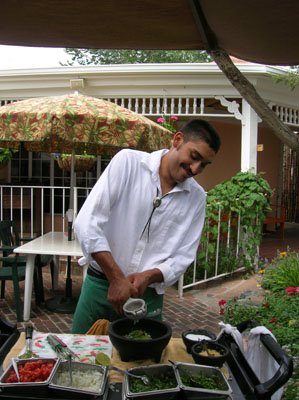
Miguel Moya squeezes a lime as an ingredient in our table-made guacamole.

Our order starts with guacamole made at the table. Miguel Moya, the guacamole master, rolls his cart upto our table, splits avocado and removes the pit and asks what condiments we want included. As we watch, he mixes up an absolutely fresh and tangy bowl of guacamole to accompany our pre-meal salsa and chips.

A couple of glasses of wine help us settle in. Barrientes recommends the Carnetas. Our choices are more traditional chimichangas and chiles rellenos. These classic Mexican dishes are prepared with refritos frijoles (refried beans) and rice, sour cream and guacamole. We loaded up the remnants with the last of our table-made 'guac.'

Our custom-made guacamole meets its natural end.

Barrientes tells us that he has been with Gabriel for 29 years, only the last 13 in New Mexico, having been his manager at Pancho Villa’s in NYC for 16 years before the restaurant operation was moved to New Mexico. Chef Saul Valdiera has been running the kitchen at Gabriel’s since it opened, transferring from the San Francisco Pancho Villa’s.

We, of course, are in town for the annual Santa Fe Indian Market. According to Barrientes, Indian Market weekend is the biggest weekend for Gabriel’s, augmented by the crowds that gather to enjoy the Santa Fe Opera, just down the road. Reservations for Indian Market start to come in around July 4th. Operagoers make up about 50% of the patronage while the season is underway.

Many of them also spend time at the neighboring art gallery that Gabriel opened about two years ago, according to Barrientes. For art, the view, good food and table-made guacamole, we will make Gabriel’s a regular on future trips to Santa Fe.

~~~~~~~~~~~~~~~~~~~~~~~~~~~~
Tribal Artery is the blog about tribal art offered periodically by Aboriginals: Art of the First Person and its allied web sites at Native-JewelryLink, with gorgeous, genuine American Indian necklaces, bracelets, pendants, pins and earrings; ZuniLink, for hundreds of authentic Native American fetish carvings by Zuni , Cochiti, Navajo and San Felipe artists; Tribal Works, offering a wide selection of tribal art from Africa, Aboriginal Australia, the Arctic and Native America, including Navajo folk art, and Native-PotteryLink, home to the finest in contemporary and historic Native American hand-created pottery, storytellers and nativity sets.

Navajo presidential candidates choose running mates

Candidates for president of the Navajo Nation, Lynda Lovejoy and Joe Shirley Jr., have announced their running mates. Each continues the practice of reaching across state lines in hopes of garnering increased support.

Walter Phelps of Leupp, Ariz., will join Lovejoy of Crownpoint, N.M., as she campaigns to become the first woman to lead the nation's largest Indian reservation.

Shirley of Chinle, Ariz., has selected Ben Shelly, a 16-year tribal council delegate from Thoreau, N.M., as he seeks re-election to a second term.

For more information, visit http://www.freenewmexican.com/news/47910.html

~~~~~~~~~~~~~~~~~~~~~~~~~~~~~
Tribal Artery is the blog about tribal art offered periodically by Aboriginals: Art of the First Person and its allied web sites at Native-JewelryLink, with gorgeous, genuine American Indian necklaces, bracelets, pendants, pins and earrings; ZuniLink, for hundreds of authentic Native American fetish carvings by Zuni , Cochiti, Navajo and San Felipe artists; Tribal Works, offering a wide selection of tribal art from Africa, Aboriginal Australia, the Arctic and Native America, including Navajo folk art, and Native-PotteryLink, home to the finest in contemporary and historic Native American hand-created pottery, storytellers and nativity sets.

Sunday, August 13, 2006

Wilson Romero’s Nativities

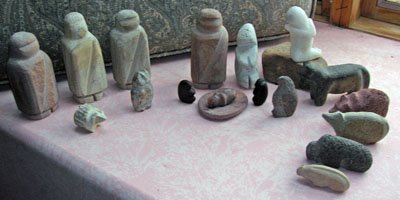
This afternoon we visited our friend, Wilson Romero on the Cochiti Pueblo. We were surprised to learn that he had some newly carved nativity sets. Wilson tells that he has had the opportunity to carve in more detail since his retirement from Pueblo business. These sets show it. Each is extremely evocative and includes a full panoply of adorers.
(Above) Three wisemen in sandstone stand watch as Mary kneels in prayer and Joseph stands at her side. Adoring creatures include an antler sheep, two small bears, three rabbits, a cow, a horse a white buffalo, another bear and a mountain lion. Perched on an overlooking rock are an owl and eagle.
(Above) This set includes three wisemen, Joseph, Mary assorted creatures such as a sheep carved from antler, an owl, two small rabbits and one larger one, a horse, two bears, a buffalo and a mountain lion.

Wilson and Annette, his wife, are two of the nicest people we know in the field of Native American art. They are always hospitable and gracious. It always is a pleasure to see them and their art.
-----------------------------------------------------------------------------------------------

Tribal Artery is the blog from Aboriginals: Art of the First Person and its allied web sites – ZuniLink, for outstanding fetish carvings from the Pueblos of Zuni, Cochiti and San Felipe; TribalWorks, for an assortment of art objects from Africa, Aboriginal Australia, Native America and the Arctic; Native Jewelry Link, for a plethora of gorgeous, authentic Native American Indian jewelry pieces and Native Pottery Link, for a wide selection of the best in Native American Indian hand-made pottery.

The Guest House

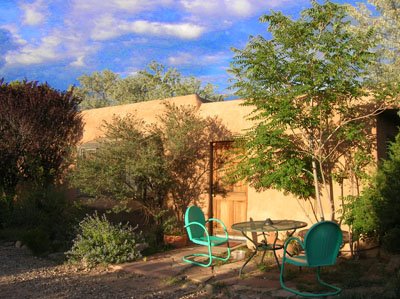
Last message we promised a photo of our temporary quarters in this charming guest house. We were unable to come through due to computer glitches. Actually it was camera glitches. Well, got them fixed and now we can show you a photo of the exterior of our charming home-away-from-home.

We also took a trip to the Plaza and walked the world-famous portal. This covered area adjoins the Palace of the Governors. Native American artists are assigned places along the wall to display and sell their goods. The ability to sell there is determined by lots being drawn. So, on any given day, you will find a different mix of artists represented. We’ll return and take some pictures for a future issue of Tribal Artery.

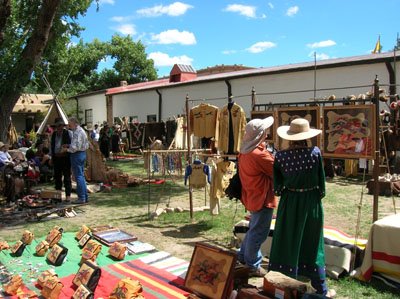
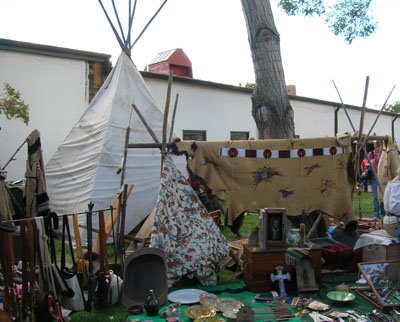
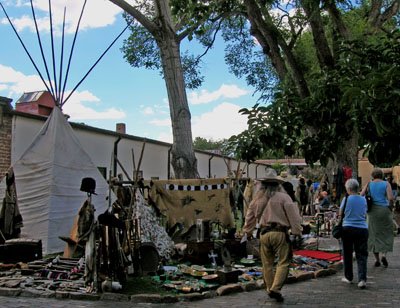
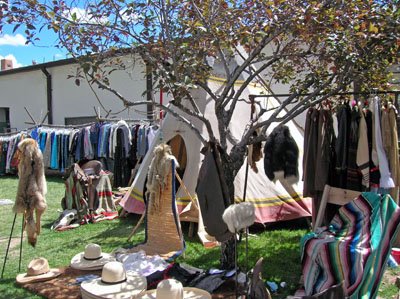
We also ventured into the Mountain Men Show area in the courtyard behind the Palace of the Governors. There were many displays of goods from the Old West – from knives and leather garments to ladies’ gingham dresses and old Indian goods.We’ll try to post some photos, if the computer permits.


One tee-pee even housed the blacksmith.


-------------------------------------------------------------------------------------------------
Tribal Artery is the blog of Aboriginals: Art of the
First Person and its allied web sites – ZuniLink, for outstanding fetish carvings from the Pueblos of Zuni, Cochiti and San Felipe; TribalWorks, for an assortment of tribal art objects from Africa, Aboriginal Australia, Native America and the Arctic; Native Jewelry Link, for a plethora of gorgeous, authentic Native American Indian jewelry pieces and Native Pottery Link, for a wide selection of the best in Native American Indian hand-made pottery.

Friday, August 11, 2006

Day One in Santa Fe

We are here. We arrived today and went to our rented guest house. It is several times nicer than the photographs the owner sent to us.

Taos, the greyhound, did okay with patches of distress that passed with time and arrival at our destination. She is now settled in on her bed from home and seems to be content. Surprise was that there are three dogs already in residence here. They greeted Taos and vice versa with great ceremony and total friendship. In fact, Taos seems to have a male friend. Every once in while we hear a scratching at the door and - yep - there he is. It is sure to be platonic since track greyhounds are neutered early on.

Two apologies. First is that we searched last night for a place to stay with wireless internet service. We passed up several suitable places to stop at this one. I won't mention names but after signing on and connecting with their network, we couldn't connect with their server. Turns out it was down and the management failed to tell us until we were checked in and settled in and it was too late to move elsewhere. So that's why there was no blog last night.

Second apology. I took a digital photo of our guest house to share with you. Oooops. I didn't pack the cable to download camera images to the laptop. Tomorrow's #1 task? Get thee to an electronics store and buy download cable. Stay tuned.

Good news. Our press pass has been granted. So we will have some extra opportunities to report on the doings at Indian Market.
-----------
Tribal Artery is the blog medium for Aboriginals: Art of the First Person and its allied web sites. Native Jewelry Link, for outstanding Native American jewelry; Native Pottery Link, for authentic Native American pottery; TribalWorks, an assortment of African, Australian Aboriginal, Native Americnaa nd Arctic tribal art works and ZuniLink with hundreds of fetish carvings from Zuni Pueblo, Cochiti Pueblo and San Felipe Pueblo.

Wednesday, August 09, 2006

August 9, 2006 - On the road

We hadn’t even left home before we had a crash. No, not the automotive kind.

Our main business computer decided to crash at about 10 pm on Monday night, just as we were packing to leave. A quick fix was not possible. So our databases are sitting in limbo. We won’t know what can be salvaged until we return.


Fortunately, thank heavens for back up files and back-up computers. Most of the files also were loaded onto the laptop – on which I am now composing – and have since been downloaded to memory sticks for safe storage and eventual transfer back to the main computer.

Anyway, despite the dysfunctioning computer, we departed on time Tuesday morning. The ride was eventful only because of our concern that Taos was comfortable. Each stop led to a redistribution of our cargo to make more space for her. In some ways, although she seems to be traveling well, she is more ocnern than a child. We can’t know for sure if she is content or not. Her appetite seems to have been affected by the stress (or unusual quality of long stretches in the car.)

Our first day was a 10-hour drive with an overnight stop at a pet-friendly motel in Mobile. Thanks to take your pet along for guidance and a directory of such places along the way. When we harvested email last night, there were two messages of special interest. One was from a person who is looking for a piece by Kathleen Wall of Santa Clara. We were able to tell her we will look to see what is available from Kathleen while in Santa Fe. And on our trip to visit our friends at Santa Clara Pueblo. This reminded us that we can do the same for anyone who is looking for something special. Just let us know by email to sanibelart@comcast.net

The seocond was a reminder that the 22nd Annual Mountain Man Fair and Rendezvous takes place at the Palace of the Governors in Santa Fe. It starts August 9 and runs through August 13. The notice included a word we had never heard before, “foofaraw”. We’re not sure what it means but we will check it out while we are in “The City Different.” And will report on all the “foofaraw.”

Thanks for stopping by. More to come to morrow. Hasta then.


Sunday, August 06, 2006

With Taos to Taos

In two days time, we will depart by Honda Element for Santa Fe. We will be accompanied by our beloved “Taos”, a retired (rescued) greyhound. That's her sitting with Susanne at a recent doggy day on Sanibel Island.

We have anguished over how to handle her transport and lodging en route. Since we will be on the road for three days, we want her to be comfortable, but safe. We started out with a cage, and did a little rehearsal, but that spooked her too much – despite the fact that racing greyhounds are raised in cages.

Then we tried a harness bungied to the sides of the compartment. That spooked her even more. So we decided we would just put her bed on compartment floor and hope for the best.

We were lucky to find a rental in Santa Fe that accepts renters with a dog. And we found an online service, takeyourpet.com that lists motels that allow dogs. So we think we have ourselves – and Taos – handled. Copyright 2006 Aboriginals :Art of the First Person

We will start our blog messages with our first day on the road, assuming some of you might be interested in how it goes.

Once we get there, we have applied for a press pass so that we can get the inside skinny. If that fails, we will give our “man-in-the-street” impressions.

Incidentally, Taos is another charming New Mexico town about one hour north of Santa Fe. We undoubtedly will make a side trip there. It is the home of the oldest continuously inhabited multistory community in North America, the Taos Pueblo. It also was home to a ski lodge that Susanne and I owned, and our son managed, in Taos Ski Valley. We’ll be eager to see what has changed in this town where time moves very slowly.


Also incidentally, if you have any interest in adopting (rescuing) one of these wonderful creatures, take a visit to Second Chance for GreyHounds.org . This is an excellent portal for adoption . I can assure you that you will never have a more docile, loving pet. Or one that bonds more quickly. We have had four over the last ten years.

Watch for our future blogs from Santa Fe Indian Market. You also can visit our websites at ZuniLink and Native American Jewelry. We will have most of that inventory with us and will be able to fulfill from Santa Fe.
Copyright 2006 Aboriginals:Art of the First Person

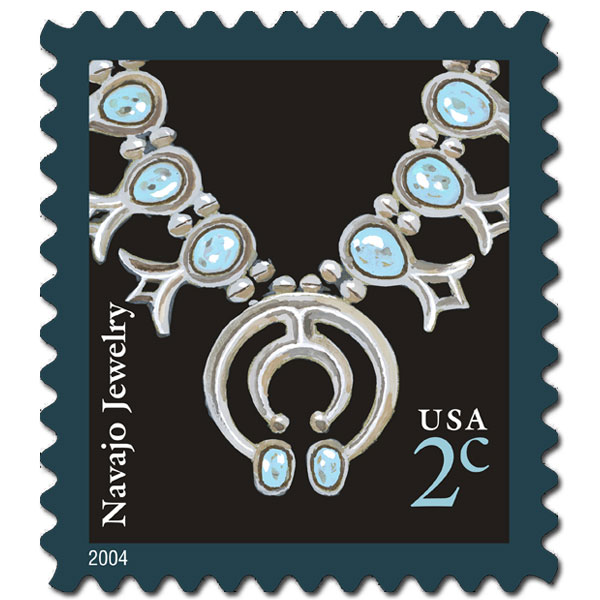
More than 2 cents worth


A while back we blogged about a USPS stamp series that saluted Rio Grande Hispanic weavings. For some reason, we missed this stamp which was issued by the United States Postal Service (USPS) in 2004. About one hundred million copies of the stamp were printed originally. In January, 2005, the USPS cranked out an additional 2 billion copies – anticipating the need for 2-cent stamps when the 1st Class rate went from 37 cents to 39 cents.

The subject “squash blossom” necklace was photographed from a private collection by Peter T. Furst, anthropologist, author and photographer. The image then was painted by artist, Lou Nolan. That image was reproduced to create the stamp image.

The stamp, part of the Definite American Design series can still be purchased at Post Offices and throught he USPS web store.

Wednesday, August 02, 2006

Sale Ends; Bargains Continue

Did you take advantage of our 10-day special sale? Lots of people did and saved a bundle.

If you missed it, do not despair. Even without the extra discount, subscribers to our free Tribal Artery email newsletter receive an automatic 10% discount. (See below to sign up for your free subscription.)

The email newsletter is issued about once a week, usually on Sunday, so that you can read it at home on Sunday evening or find it waiting in your email inbox on Monday.

The subject matter is a mix of news about specials and interesting art objects in the Aboriginals Galleries, and reflections on newsworthy events elsewhere in the world of tribal art.

Our communication plan is to provide briefs in the enewsletter linked to expanded discussion in this blog.

Back to the bargains. It is a fact that it costs less to run an online gallery than to staff and pay rent for a physical store. So, when we closed our Sanibel Island physical gallery, we reduced our regular prices on line. Moreover, if you have spent any time in major galleries throughout the Southwest and major cities, you will know that our prices are at least as low if not lower for art objects that are at least as high quality as the competition's inventory.

We also work hard to represent artists whose work is not widely available. For example, Cochiti carvers, Salvador and Wilson Romero, are featured in just a handful of online and offline galleries. Zunilink at Aboriginals in one of those sources. The other is Keshi in Santa Fe. We identify them here because, frankly, if you are looking for a nice Salvador carving, and we don’t have what you want, we would rather have you get it there than go without.

Similarly, we carry carvings by Melvin Sandoval, a member of the San Felipe Pueblo whose wife is Zuni. Melvin’s carvings are unusually smooth and fluid, reflecting a distinctly impressionistic style.

We also carry work by Delbert ChargingCrow, Lakota Sioux, and Andrew Rodriquez, Laguna.

Andrew’s home is Mesita, New Mexico, but he currently lives in Albuquerque. He attended the Institute of American Indian Arts in Santa Fe. While there, his mentor was the renowned Allen Houser. He later earned a degree, with distinction, in Fine Arts, from the University of New Mexico.

He works in clay plaques with deep relief and in sculpture, favoring white clay with a stone polished white slip. His plaques characteristically are matte finished in white or bisque. They make stunning wall décor, especially as the day’s light moves across their surfaces, changing the character of the vision as it goes.


We hope to see Andrew, Salvador, Wilson, Melvin and Delbert at Indian Market this year. Watch for our blog messages from Indian Market starting August 12, 2006.

This issue of Tribal Artery, the blog, comes to your from Aboriginals: Art of the First Person, with web sites at Native Jewelry Link, Native Pottery Link, Tribal Works and ZuniLink. We have provided links to individual artists above, in addition to these site links. You may subscribe to this blog by putting us on your feed list or you may subscribe to our email newsletter,

here.

Sunday, July 30, 2006

Final Days of Alice Cling and Calvin Begay Sale

August 1st is the last day of our 25% off sale on Calvin Begay Navajo jewelry and Alice Cling pottery (see inset).

Just visit our Pueblo Pottery website and select the Alice Cling, Michelle Williams, Susie Crank or Sue Williams pot you want to purchase and email us or send us the order form witht he appropriate information. Be sure to include the code, "AC25%" in your order. We will respond by email with the discounted price and shipping charge, and work out payment from there.

To purchase a piece of Calvin Begay's beautiful jewelry, visit his pages at our Native American Indian jewelry web site and navigate to oneo his pages. We have Calvin's bracelets, earrings, necklaces, pendants and pin/pendants. All are 25% off if you enter the code, "CB25%" on your order. Our email response will tell you what your cost is after the discount and estimate shipping charges.

Please note that the prices shown on the web site are NOT the prices you will pay during this sale. To determine that for yourself, just deduct 25% of the listed price.

We encourage you to act now. This sale ends in two days. We look forward to hearing from you.

Recent Native American Art Auctions

A recent auction generated some impressive Native Americana sales.

Skinner, a Boston auction house, dropped the hammer on a Cheyenne cradle board from the quarter of the 19th Century for $88,125. A Southern Plains Cheyenne beaded woman's dress of hide dating to the third quarter of the 19th Century sold for $47,000. A mid-19th Century war axe from the Plains Prairie Missouri people realized $44,650. An Apache basket done in polychrome pictorial techniqque with an estimated age of about 100 years (ca 1900) went for $37,600. A polychrome carved wood mask from the Kwakiutl of the Pacific Northwest received a winning bid of $28,200. The auction was held in May, 2006.

We will try to offer more news about auction results in tribal art in future editions of Tribal Artery. Stay tuned by visiting http://www.tribalartery.blogspot.com regularly.

On Authenticity, Antiquity and Aesthetics

The most recent edition of African Arts magazine, published by the James S. Coleman African Studies Center, UCLA International Institute, University of California, Los Angeles, Lorenz Homberger and Christine Steizig comment on an exhibition – With the Eyes of an Aesthete: Art from Gabon – at the Volkerkundemuseum der Josefine und Eduard von Portheim-Stiffung in Heidelberg, Germany. They wrote, “…many of the objects shown in Heidelberg are contemporary reproductions and therefore highly problematic to the trained eye. However, a visitor or reader unencumbered by such prior knowledge cannot recognize this.”

The article, which I encourage you to read, goes on to complain that the presence of reproductions constitutes a threat to the field of African art, particularly when presented in art museums, where they might be construed as “authentic antique originals” or, at least, take on the halo of legitimacy from their association with a museum.

Whenever this subject arises, as it does often in at least one African Art discussion group on the internet, I always wonder if there is no place in the world of African art for extraordinarily produced carvings that are less than 50 years old; must the field be limited only to art that can be proven to be antique and “original”?

And what about the proof? Provenance is required to establish the ownership trail back to its original source. Yet, provenances are only pieces of paper and they can be as authentic or false as the persons who present them.

But, in the matter of aesthetics, does it matter if a carving or mask has no provenance but represents an outstanding example of a genre and a true pleasure to eye? Is such an item a “fake”, a favorite term of the “cogniscenti” when referring to such pieces, if they are not presented as antique or valued at the level of pieces proven to have been collected in the 1800s.

Is it not possible to treasure and love and take great pleasure from such pieces regardless of the “authenticity” placed on them by third parties, who frequently have their own egocentric or economic interests in similar pieces.

This is not presented as a defense of “fakes” when they are presented as something they are not. If, however, they are presented fairly, accurately as to provenance and age, and with a money-back return privilege, it seems to me to be reasonable to have and support a market in such items – at prices that are appropriate for the quality, authenticity and age of the item. And art museums would seem to be an acceptable venue for exhibiting them.

What do you think?

~~~~~~~~~~~
Tribal Artery is the periodic blog of Aboriginals: Art of the First Person, a tribal art dealer with web sites at
http://www.TribalWorks.com for African, Australian, Navajo folk art and Arctic art; http://www.Native-JewelryLink.com for Native American jewelry;
http://www.Native-PotteryLink.com for Native American pottery and http://www.ZuniLink.com for animal fetish carvings from Zuni, Cochiti, Navajo and San Felipe. Thank you for your attention and interest.

Monday, July 24, 2006

Scroll down for savings


If you are here to read about the 25% savings during our sale of Navajo pottery and Calvin Begay Navajo jewelry, please scroll down to a previous blog posting. Thank you.

Sunday, July 23, 2006

Events at Indian Market 2006

The latest from the Southwestern Association for Indian Arts (SWIA) includes a schedule of activities for the two-day Santa Fe Indian Market. All of these activities will take place at the gazebo in the Santa Fe Plaza:

Saturday, 8/19

7 AM --- Official Opening Ceremony

9 AM --- HawkQuest - Educational session about birds of prey

12 Noon --- Honoring Ceremony

12:30 PM --- HawkQuest program repeated

1:40 - 2:10 PM --- Radmilla Cody (Navajo), a Canyon Records recording artist performs

2:30 - 2:50 PM --- Bill Miller (Mohican) trio, two-time Grammy Award winner performs

3:10 - 3:50 PM --- Spirit Wind Pueblo Singers perform with dancers

3:30 - 4:00 PM --- Jemez Senior Singing Group performs

Sunday, 8/20

9 AM --- Native American Clothing Contest

12 Noon --- HawkQuest program repeated

1:40 - 2:10 PM --- Ananeah (Inter-tribal) fusion group performs

2:30 - 2:50 PM --- Shelly Morningsong (Northern Cheyenne) performs

3:10 - 3:30 PM --- Soni of Ulali (Mayan/Apache/Yacqui) performs

3:30 - 4:00 PM --- Moeity (Inter-Tribal) performs

4 PM --- Closing Ceremony and thank-yous from SWAIA

All of these ceremonies and performances are in addition to the other auctions, shows, sales, artist booths and general bustle of the Market.

Please come back to the Tribal Artery blog as we post daily reports from Santa Fe Indian Market. Thank you.

Thursday, July 20, 2006

Alice Cling and modern Navajo pottery.

Alice Cling is the daughter of Rose Williams, a ground-breaking potter from Tonalea in the Navajo (Dine’) Nation. Prior to her influence, Navajo pottery was essentially utilitarian with heavy pine pitch coating.

Rose and Alice began the movement toward more refined and finished pottery forms, stimulated by a growing awareness of the market for fine Indian pottery. Whereas tourism, museums and widespread trading drove the pottery of the pueblos, Navajo pottery bloomed primarily under the influence of Alice Cling’s beautiful shapes and softly polished and fired pitch slips.

The clay for Alice’s pots and those of her family including Susie Crank, Sue Williams and Lorraine Williams, comes from the secret deposits near Black Mesa. After being dug up and purified, it is tempered with sand and water, making it malleable.

Alice was born in Cow springs in the mid-40s, graduated from school and married Jerry Cling. Their four children are also potters, carrying on the new Navajo pottery tradition.

Alice’s work, which started out as crude and “ugly”, to use her word, has evolved into bowls, vases and ollas with a warm, red-brown-orange surface, with hints of purple and blooms of juniper fire clouds. The coloration comes in part from the iron content in her slip and partly from the conditions in her outdoor firing pits. After firing, Alice burnishes the pots' surfaces with a smooth stone or stick.

The final product has won numerous Indian market and show awards and is highly prized by Native American Indian pottery collectors, realizing handsome prices for its excellence.


As a salute to Alice Cling and her Navajo cohort, our web site at Native-PotteryLink.com is offering a private pottery sale with 25% off all Alice Cling, Susie Crank, Sue Williams and Lorraine Williams Navajo pottery. To receive this special, limited time discount, you must visit the Navajo pages at our Web site and use the term "AC25%off" when placing your order so we will know that you learned about the sale on our enewsletter blog. The reduction will be taken at the time of purchase.
~~~~~~~~~~~~~
Tribal Artery is the periodic enewsletter blog of Aboriginals: Art of the First Person on behalf of its web sites at Native-PotteryLink, ZuniLink, TribalWorks and Native-JewelryLink. Thank you for joining us.

Calvin Begay Sale

Speaking of favorite people and their work, Calvin Begay is near the top for us. Calvin is Navajo and has a style and touch that is unmistakable with fine and precise inlay and channel work in jewelry pieces. Starting as jewelry maker, he has evolved into a designer as well, supervising the manifestation of his ideas at A Touch of Santa Fe. Calvin’s work may be signed by him personally, by one of the members of his atelier or simply stamped with ATF. But they are all Calvin Begay pieces.

For a limited time, one week only, our web site at http://www.Native-JewelryLink.com is offering a private sale discount 25% off of every item of Calvin Begay jewelry to anyone reading this blog post. To take advantage of this private sale, which ends August 1, 2006, you must visit the site and order the item(s) you want to purchase. When you order via email message, be sure to use the term "CB25%off" to identify your authorization for our limited time 25% discount off Calvin Begay jewelry. Thank you.
~~~~~~~~~~~~~
Tribal Artery is a regular enewsletter blog published by Aboriginals: Art of the First Person on behalf of its web sites at Native JeweryLink, Native PotteryLink, ZuniLink and TribalWorks.

Wayne Snowbird is back

We received a phone call this week from Wayne Snowbird of Santa Clara. He has been in Nebraska for the past year and now has returned to his studio at Santa Clara Pueblo. His work is the elegant black figurative pottery representing Native American individuals.

Wayne tells us he will be in Santa Fe for Indian Market. We look forward to seeing him.

Winners and losers at IACA Spring Market

The Indian Arts and Crafts Association held its annual Spring Market in Albuquerque in May, 2006, during which it named and honored its nominees for outstanding artists of the year. These winners are listed below.

First, let us recognize that there were losers. They were all of us in the Indian Arts and Crafts movement. We lost long time supporters of the cause in the passing of Betty Numerof, Ruth Scott Kiernan and Dr. Rita Yokoi.

Ruth Kiernan died on March 1, 2006. She was the proprietor of one of the industry’s most respected Indian art trading companies, and was regularly represented at the IACA wholesale shows. Betty Numerof died on April 17, 2006 at the age of 80 and after several successful terms as president of the IACA. Dr. Rita Yokoi, who died on May 24, 2006, was the owner of Silver Hills, a wholesale dealer in Native American jewelry with a specialty in work from the Santo Domingo Pueblo. She also founded the Museum of Native American Jewelry in California. All three of these monumental women represent a huge loss to those who knew them, those who loved them and those who did business with them. We all are lessened by the loss.

Now to the winners, The following artists were recognized by the judges at the IACA Show:

Easel Art – Frank Fowler (First), Frank Fowler (Second), Daniel Ramirez (Third);
Jewelry/Lapidary – Bennard Dallasvuyaoma (First), Michael Kirk (Second), Veronica Poblano (Third)
Jewelry/Metalsmithing – Amelia Joe-Chandler (First), Al Joe (Second), Al Joe (Third);
Katsinas – Alexander Youvella Sr. (First), Alexander Youvella Sr. (Second), Prinston Collateta (Third);
Pottery – Randall Blaze (First)
Sculpture/Large – Upton Ethelbah (First), Ron Mitchell (Second);
Sculpture/Small – Randall Blaze (First), Upton Ethelbah (Second), George Shukata Willis (Third)
Traditional – Rosie Yellowhair (First), Tammy Beauvais (Second), Venus Brightstar (Third).

Best of Show was awarded to Alexander Youvella Sr.
Artist of the Year – Amelia Joe-Chandler.

Congratulations to them all. I’m sure we will see all or most of them at Indian Market next month.

Monday, July 17, 2006

July 16 Tribal Artery message

This Tribal Artery blog reproduces the contents of the July 16th Tribal Artery e-newsletter. With a few corrected links. (Don't ask. )

Major sales of the last month.

We’re pleased to report that some important pieces are heading out to new homes.

Among them is a gorgeous painting by Tasmanian Aborigine, Max Mansell. His rendition of sunset – sunrise gives us a look at the star-filled night sky, home for so many Aboriginal Dreamtime settings, bracketed by the colorful features of nightfall and day break. This acrylic on canvas painting is on its way to Washington D.C. The new owner found us on the Web after learning about the closure of our Sanibel Island gallery. She reported that she had visited the gallery several times and had her eye on this painting. She was disappointed to learn we were no longer there. But she found us on the web as have so many of our regular customers.

In addition, two of our favorite personal collection pieces have found new homes in Miami: a Dan (Cote d’Ivoire) heddle pulley and an Ashanti (Ghana) akua ba. Both were extremely well carved with great esthetic sensitivity. The buyer did a lot of research and determined that the akua ba, while not “antique”, was so well done that a similar piece had been collected by a highly regarded museum. Both pieces had been exhibited at the Owensboro Museum of Fine Art while part of our collection.

Numerous Zuni and Cochiti fetish carvings also have been leaving to new homes. Emery Eriacho, of course, is ever popular and we have dozens of his carvings on site. The work of Salvador Romero and his brother, Wilson Romero, of Cochiti. also don’t gather any dust on our shelves. Both are represented in just one or two other places besides ZuniLink/Aboriginals: Art of the First Person. Both are two of our favorite artists and we look forward to seeing them and acquiring additional examples of there work when ever we can.

We also should mention the distinctive work of Melvin Sandoval, a San Felipe member who’s wife is Zuni. The fluid and impressionistic nature of his work makes almost every piece a feast for the eyes. You will not find his pieces many places beside ZuniLink.

On the jewelry front, we just received a message from a customer to the effect that a pair of earrings had found their way into the washing machine and had been damaged. He asked if they could be fixed. We are more than willing to help. We asked him to send the earrings back to us and we will take them to the artist for repair.

Other news


According to Dionne Walker of the Associated Press, a group of Virginia Indian chiefs will travel to England, to spend a week touring and discussing their history and culture as part of the 2007 commemoration of America's first permanent English colony. For Indians, it's a first step toward healing age-old scars of violence and betrayal. Approximately 60 chiefs and tribal members will make the trip. It will be the first trip to England by an official Virginia Indian delegation in more than 250 years.

Indian leaders will visit Parliament and spend two days lecturing on tribal history to students in grade schools and at the University of Kent. While there, the group also may visit the grave of Pocahontas, daughter of Powhatan, the Chief of the Pamunkey Tribe. She is buried in the southeast England region. Englishmen arriving in Virginia in 1607 encountered the Powhatan Nation, headed by Pocahontas’s father, the powerful Chief Powhatan. Pocahontas eventually married an Englishman, John Rolfe, and died while sailing on a return trip to Virginia.There are now about 17,613 Indians in Virginia, according to the U.S. Census, out of a population estimated at 20,000 in the 1600s.

Indian fare at the Fair

One of the staples of the Indian diet – at least at social occasions such as pow-wows and ceremonials is fry bread, When you attend you must trysome. In the meantime, here’s a receipe:
4 cup white flour

1 tablespoon baking powder
1 teaspoon salt
1 1/2 cup warm water
1 cup lard for frying (or your choice of oil)
Mix dry ingredients together. Add warm water to dry ingredients. Knead until dough is soft and elastic and does not stick to bowl. (If necessary, add a little more warm water. ) Shape dough into balls the size of a small peach. Let these sit for 15 minutes. Pat out a bit, pinch edges and then pat back and forth by hand until dough is about 1/2 to 3/4" thick and is round. Make a small hole in the center of the round. Melt lard in a heavy frying pan. Carefully, put rounds into hot fat, one at a time. Brown on both sides. Drain on paper towels. Serve hot.
This recipe came from Jim Bodle. A Google search will turn up many more variations.


Fry bread can be eaten with toppings like ground beef, tomatoes, lettuce, onions, and refried beans, in which case it sometimes is called a Navajo or Indian taco. Personally, we like it with honey and a little powdered sugar or cinnamon.

~~~~~~
Tribal Artery is the name of both the e-newsletter and this blog from Aboriginals: Art of the First Person and its associated web sites - Native-JewelryLink, offering top quality American Indian jewelry; Native-PotteryLink, offering superb hand-made pueblo pottery; TribalWorks, offering a wide spectrum of African, Australian,Arctic and Native American tribal art; ZuniLink, one of the Web's largest selections of beautifully carved Zuni, Navajo and Cochiti fetishes.

There is also a blue button to click to sign up for the e-newsletter version of Tribal Artery, if you are interested.You may, of course, unsubscribe at any time.


Sunday, July 16, 2006

Corrections and new stuff


In a recent post that listed upcoming events, I omitted the Eight Northern Indian Pueblos Arts and Crafts Show, which was this weekend. Arghhhh!

It was, I am told, a very good show. It tends to be overshadowed by Indian Market, less than a month away, in Santa Fe. Yet, I have been to Eight Northern in past years and found it a very satisfying show. It’s lower keyed and has many of the younger artists that have not developed the credentials to show at Indian Market.

For example, Loren Wallowingbull, a Jemez potter, was well represented with examples of her Eagle Dancer pottery figures. She ended up winning the Best in Youth Award at the show. We purchased one of her pieces from her about a month ago in Albuquerque. If I can figure out how to show it in this blog, I will do so. Otherwise, I will provide a link to its page on our web site.

Also as part of our mea culpa, I have to report that some of the links we provided in the calendar either were listed incorrectly or were inactive. We will try amend that bad info here. The schedule for events at Indian market can be accessed at
http://www.swaia.org/schedule.php . To volunteer as an Indian Market worker, go to http://www.swaia.org/volunteer.php

I also failed to vet the web address I was given for White Hawks Shows. It is broken. I apologize.

Finally, looking back in the archives of this blog, a found a number of comments that were unsavory. I had left the comment option open so people could freely add their thoughts. Two things happened. First, most of the comments were nothing more than people finding a way to promote their web sites. I really didn’t have a problem with that. But then some of the sites bordered on pornographic. So I have changed the guidelines for comments. They will have to be reviewed and approved by me before being posted on the blog. I am sorry for those who have to go through an extra step to put their two-cents worth in and for those who might have been exposed to the offensive content before I closed it down.

Follow this blog for more news about the world of tribal art. Thank you for your attention.

Friday, July 14, 2006

Get the Tribal Artery newsletter

In addition to this blog, we also offer a periodic e-newsletter by the same name. Occasionally, the e-newsletter will have discrete content but most times it will be an alert about the Tribal Artery blog. So if you don't want to subscribe to the blog but you want to be alerted to updates, why not sign up for our newsletter?

Heres the link.

Subscribe'>https://app.quicksizzle.com/survey.aspx?sfid=21121">Subscribe to the Aboriginals: Art of the First Person newsletter

Blogging from Santa Fe

We will be blogging from Santa Fe during the upcoming 2006 Santa Fe Indian Market.

If you have ever attended this market, you know how exciting it is. Native American artists from across the country bring their art for display and sale at this event. The basic event is bracketed by other events, auctions, shows and charitable get-togethers.

If you are interested in being at the market vicariously, visit this blog regularly. We will be posting daily reports of our experiences and observations.

If you are in the Santa Fe area during market, you may want to volunteer to help with the market logisitics. Contact http://www.swaiai.org for more information.
~~~~~~~~~~~
Tribal Artery, the blog, is a regular communication about events in teh world of tribal arts from Aboriginals: Art of the First person, with web sites at http://www.TribalWorks.com for African Australian, Arctic and Native American folk art; http://www.ZuniLink.com for Zuni, Cochiti and Navajo fetish carvings; http://www.Native-JewelryLink.com for superb Americna Indian jewelry and http://www.Native-PotteryLink.com for the finest American Indian ham-made pottery and storytellers.

Frank Willett passes

We have received word that Frank Willett, CBE, FRSE and former director of the Hunterian Museum and Art Gallery, passed away on June 15, 2006 at the age of 80.

We did not know Professor Willetts but we were educated about African tribal art by his research and writings. We are grateful for his time spent in the field and making us all wiser about his subject and saddened to hear of his passing. We extend our condolences to his family and friends.

Wednesday, July 12, 2006

Coming events for July and August

The following is a list of events in the Indian Arts and Celebrations World scheduled for July and August 2006.

July 22-23 Pikes Preak Western Collectables Show, Colorado Springs [CO] Masonic Temple, Contact/info 719-635-0588

July 26-30 Gallup Intertribal Indian Ceremonial, Gallup [NM]. Contact/info gallupnm.org or 505-722-2228

July 27-28 Smoki Museum Navajo Rug Auction & Cowboy & Indian Art Auction Prescott [AZ]. Contact/info smokimuseum.org or 928-688-2777

August 11 Best of Santa Fe 2006, El Dorado Hotel and Spa, Santa Fe [NM]. Contact/info allardauctions.com or 888-314-0343

August 11-13 Antique Ethnographic Art Show, El Musei Cultural de Santa Fe, Santa Fe [NM]. Contact/info whitehawkshow.com

August 14-16 Invitational Antique Indian Art Show, El Musei Cultural de Santa Fe, Santa Fe [NM] Contact/info whitehawkshow.com

August 18-20 Antiques of the Americas and Beyond, El Musei Cultural de Santa Fe, Santa Fe [NM] Contact/info whitehawkshow.com

August 19 Santa Fe Indian Market, Santa Fe [NM] Contact/info swaia.org

August 26 Friends of hubbel Native Art Auction, Ganado [AZ] Contact/info friendsofhubbell.org or 928-688-2777

September 3 Page Blair's Native American Art Auction, The Gunsmoke Saloon, Page [AZ] Contact/info 928-688-2777
~~~~~~~~~~~~~~~~~
Would you like to have your Indian or Tribal Art event listed here? Email information to Tribal Artery

More about the cost of silver

The July issue of The Indian Trader carries an article on the increasing cost of silver and its impact on Native American silversmiths. (The Indian Trader is a hard-copy monthly newspaper. It does not have a web site but subscriptions by mail are quite reasonable. Call 800-748-1624 to subscribe.)

The article cites the story of Seraphine Wilson and Justin Wilson Jr, members of the Navajo tribe, who have found the 117 per cent increase in silver prices over the past year requiring them to work longer hours in order to produce sufficient product to make money.

The Indian Trader quotes brokers that the "cost will nearly double again, hitting between $20 to $30 an ounce by the summer."

The Wilson's claim to be working 12 to 14 hours a day vs. the 8 to 10 hours a day that they worked when silver was less expensive. They also drive the 75 miles from their home on the Navajo reservation to Gallup two or three times a week, where they sell their product to dealers and traders and buy replacement silver to work with. The Indian Trader quotes Wilson as saying, "We're not buying as much silver as we used to."

The impact of the price of silver on Native American jewelry production is yet to be seen in full. It is not impossible, however, to anticipate a reduction in authentic Native American silver jewelry and an increase in the cost of it.

We are covering this subject because we don't want people who are thinking about buying Navajo or Zuni silver jewelry to delay to the point that their price and selection options are severely limited.
~~~~~~~~~~~~~~~~
Tribal Artery is an occasional blog about Tribal Art from Aboriginals: Art of the First Person and its allied web sites, Native-JewelryLink, for authentic jewelry from Navajo, Zuni and other Native American artist, Native-Potterylink, for superb, authentic Native American pottery, ZuniLink, for outstanding authentic fetish carvings from Zuni, Cochiti and San Felipe, and TribalWorks, for a pot pourri of Native American folk art, Australian Aboriginal art, Arctic and Pacific Northwest art and African tribal art.

Thank you for visiting. If you would like to subscribe to our periodic e-newsletter, also called Tribal Artery, click on the blue button when you visit one of our web sites.

Sunday, July 09, 2006

There's gold in that 'thar' jewelry

Actually, there’s a lot more than gold and a lot more value than there was just three years ago.

In July, 2002, the price of gold was between $303 and $319 per ounce. Today, an ounce of gold is quoted on the spot market at $632 per ounce.

Silver has been no slouch either. In July, 2002, an ounce of silver would have cost between $4.82 and $5.05. Today, it’s worth $11.38.

My math calls that doubling in value.

Now, this is not an argument for going out and buying gold or silver bullion as an investment. It is a fact, however, that prices that were set by many Native American jewelry sellers based on 2002 costs have not been raised since then. Specifically, Aboriginals: Art of the First Person’s Native American jewelry web site,
http://www.native-jewelrylink.com , which specializes in top quality Hopi, Isleta, Navajo and Zuni jewelry is still charging the same price for its gold and silver jewelry as it was three years ago.

Today’s replacement cost for those items comes close to today’s retail price. In fact, during our most recent trip to the tribal jewelry-makers of Arizona and New Mexico, we were told by at least one highly respected name artist that she no longer works in gold because of its cost.

Which makes gold and/or silver jewelry, hand-made by the artisans of Native America, an extraordinary value at today’s prices. And the beauty of the work makes it a far superior investment to precious metal bullion. After all, you can’t wear a silver bar.

Native-JewelryLink is pledged to hold its Native American jewelry prices right where they are for the time being. And, as a reader of our e-newsletter and blog, Tribal Artery, if you identify yourself by citing the promo code “Tribal Artery”, we will give you a 10% discount right off the top of any regular current price if you order before August 1, 2006.

Happy prospecting.


Editor's Note: It has been several months since our last blog posting. Thanks for revisiting. We plan to be more active in future weeks. In the meantime, our web sites at ZuniLink and Native-PotteryLink remain active, with new items being posted whenever they arrive. We welcome your visit.

Saturday, February 11, 2006

More shipping - to exotic (for us) places

We recently shipped a pair of Australian Aboriginal "mimih" figures from our web site at Tribalworks to a collector in Italy. It was a packing challenge due to the long, skinny nature of the pieces - and the destination.

Mimihs are part of Aboriginal mythology, representing spirits that live in the cracks in the rocks of the escarpment. They are often used, as are koshares among Native Americans and "boogeymen" in pop culture, to scare youngsters into the proper behavior.

This collector acquired them for a traveling display of totems that he has put together.

We also have fetish carving collectors in the UK who buy regularly from us. Shipping there is no problem.

Headed in the other direction we have shipped Native American jewelry from our Native Jewelry site to Australia and have shipped repatriated Australian Aboriginal paintings and aritfacts to "downunder." Come to think of it, we have shipped several items of Native American jewelry and Zuni fetish carvings to Japan and Hong Kong.

It is exciting to be dealing worldwide, and to know that material culture from tribal societies is going out around the world to advance the spirit of artistic appreciation and cultural understanding.

Shipping charges and other matters of cash

A discussion group to which we belong has seen a recent rash of messages about shipping arrangements. It's something attached to almost every Web transaction, whether from a web site such as ours or on purchases via eBay or other auction sites.

When posting items to eBay - we have a store their under the name "Art of the First Person" - we are confronted with the question of how to include shipping charges. Customarily we have offered a flat fee. That way the bidder knows the most it will cost to ship to anywhere in the US. We estimate the cost - even for items bought from our web site - since we don't live next to the post office and can't provide the weight and postage for each package before hand.

If we are over on our estimate, we usually include a check in the package with the goods so that the buyer doesn't pay for our overestimate. If we are under, we usually just eat the difference as a cost of doing business. There are exceptions, of course, but they are rare and based on individual cases.

We have considered factoring the shipping cost into the price for the goods and shipping "free". Of course, it isn't free because it means the cost is covered in the price for the item. But it is finite and predictable. We find those two considerations are important to some people. We do offer free shipping on web items as a special promotion at certain gift-giving times of year, in order to provide an incentive for action.

The other mode is what eBay calls calculated and we call actual cost. When we are dealing with odd-sized and shaped items from the web site, we will agree to bill the buyer the exact cost for the shipping, after the fact. We can do this if we have acquired their credit card information and they consent to that way of doing it. On eBay, we indicate that the shipping will be calculated based on the desired mode and the destination.

We doubt that anyone buys an item because of shipping charges but we suspect, at least on eBay, they may decide not to bid if they feel the shipping charges are out of line.

How do you feel about this part of buying and selling? We'd love hear some other opinions.

~~~~

We update this blog when events suggest or available time allows, usually both. We also use it as a way to alert readers to new items available at our web sites - Native American Jewelry , Native American Pottery , ZuniLink and Tribalworks .
At the first, we have just added some beautiful pieces by Calvin Begay of the Navajo (Dine') Nation. At the second, we have just reorganized the entire site according to tribal origin of the potter. At the third, we have some carvings about to go up from various Zuni artists. And at the last, we have just added a bunch of fun Australian Aboriginal pottery pieces, some at prices below $40.

You can subscribe to this blog by clicking on one of the feed buttons to the right or by selecting "TribalArtery" within whatever feed provider you now use.

Thursday, February 09, 2006

Nifty Australian Aboriginal pottery creations

Our last post was about Native American pottery and Native American jewelry.

Tonight, we announce that we have added several pieces of Australian Aboriginal pottery to our site at
http://www.tribalworks.com . If you use this link, navigate to the Australian Room and then click the button for "pottery".

Australian Aboriginal pottery? How can that be? They have been essentially nomadic in the desert, limiting their interest in anything more difficult to carry than baskets and wood implements, and without a potting tradition in north, except for some Tiwi work.

This story is about a company in Alice Springs called Walkabout. It was formed by a European woman who acquired clays, slurried them and poured them into molds to be fired as pieces of pottery.

After firing they were painted by local Aboriginal women using traiditonal dot techniques and traditional iconography. We understand that the painters were on their own for the patterns and subjects they added to the pottery.

When we first met Simone in Alice, we were struck by the charm of these pieces, which are molded as boxes and creatures - koalas, kangaroos, wombats, birds and frilly lizards. On later trips, we made a point to find her and pick up additional pieces. Our last trip to Alice, Simone was making sounds of selling out. So we bought a ton of pieces. They are now almost all gone. We found the latest items to be posted in box that we put away and forgot.

These pieces are an extraordinarily inexpensive way to get a bit of Aboriginal Australiana. To go directly to the page
click this link.

We think you will find them fun to look at.

Wednesday, February 08, 2006

Web sites redesigned for easier navigation

Life is an evolutionary process. In that respect, web marketing reflects life.

After spending many hours putting up not one, but four, Web sites, it finally dawned on the Web master that navigating them wasn't very shopper-friendly.

So now, two of them, http://www.native-jewelrylink.com and http://www.native-potterylink.com , have been reorganized for more convenient shopping.

For the jewelry site, we have organized pages by category and listed the menu so that people seeking bracelets can find the pages they are on and only visit those pages if that is their preference. The same is true for people seeking necklaces, earrings, pendants and pin/pendants.

Within this structure, we also created pages that feature the works of one of our favorite Navajo artists, Calvin Begay. So that fans of this phenomenal inlay artist and jewelry designer can go directly to pages that have his versions of the above jewelry items.

The results have been gratifying already with significantly more "conversion". That's a trade talk word for people who visit the site and actually buy something.

Today, phase two was completed with the posting of the newly reorganized pottery site. Now each tribe's potters are represented on their own pages, within the bounds of available work. Looking for Navajo pottery? Visit the Navajo page. Looking for Hopi pottery? It has it's own page too. Some Pueblos, whose work has recently been reduced by sales activity, must share their pieces with other Pueblos. For example, Acoma and Isleta. Another example is a single page shared by and devoted to the work of Wayne Snowbird (Santa Clara) and Andrew Rodriquez (Laguna).

Since the dealers day is never done - hence, the scarcity of these blogs - it now is time to photograph and post some new arrivals. In the meantime, Valentine's Day is just around the weekend and we can still ship to someone you love. Why not pay us a visit?

Thursday, January 12, 2006

Storytellers tell a lot

Storyteller figures have been a staple of Pueblo pottery ever since Helen Cordero, a Cochiti Pueblo potter, developed the genre. Today, her works are highly collectable and highly valued.

Now, other potters from other pueblos are also creating storyteller figures.

Perhaps their attraction is their charm as creations. While they adhere to the same high standards required of all top-quality pueblo and native pottery, they also feature the creative spirit of the potter in the poses of the storytellers, the expressions on his or her faces, the costumes, the number and placement of children and the objects they are holding. Add to this the adventurous quality of potters who take their storyteller ideas into the realm of bears, cats, mice or dogs, for instnace, and you have an unlimited range of possibilties.

Everyone of them is designed to make the observer smile.

At our pottery web site, http://www.Native-PotteryLink.com we now have four pages of storyteller figures on display and for sale. There are works from the Fragua family of Jemez, Angel Bailon from Santo Domingo, Mary Small, also from Jemez, Stella Teller from Isleta, Cheyenne Jim from Navajo, Marilyn Lewis from Acoma, Linda Askin from Santa Clara, Annette Romero from Cochiti, Mirabel from Taos and others. To see them, simply click on the above link, scroll to the bottom of the home page and click on any of the "pot-links" labeled for "storytellers" (There are four of them.)

There also are some other very nice figurative pottery pieces from Andrew Rodriguez of Laguna Pueblo and Wayne Snowbird and Gary Gutierrez of Santa Clara.

If Native Jewelry is your Indian Art of choice, pay a visit to our Native Jewelry Link site, to see some gorgeous pieces by the best jewelry artists in the native community.

The artists that do this work, regardless of the genre, are absolutely fabulous in their skill and sensitivity.


Here comes the taxman

Somewhere around the end of January the W-2s and 1099s start to roll in. A sure sign that tax time here.

As an online merchant, we have been spared sales tax collections on any purchase that originates outside of Florida. Multiply that situation by the millions of online merchants and billions of online purchases and you can imagine the zillions of dollars in sales taxes that are not flowing into most state's coffers.

This makes the state treasurers mad. If these purchases were being made in bricks and sticks stores, the state would be getting its cut.

Without moralizing about whether the states have those taxes coming or not, they clearly could use the money.

So, guess what. They are working on ways to collect it.

To date the states have been unable to collect tax on out-of-state purchases because the law says they can't force a merchant in another state to collect their tax. Unless there is a nexus. That is, if you buy from a merchant that has a branch in your state, even if you are purchasing from a store or warehouse in another state, they must collect the tax for the state in which you reside and transmit it to that state.

Now, several states have entered into an agreement with the objective of reciprocating on sales tax collections. One state says, if you require merchants in your state to collect tax on sales from people in my state, I will do the same on merchants in my state when it comes to purchases by residents of your state.

Of course, one of the problems with this is that many states have local options that allow counties or cities in the state to add a local sales tax. With thousands of different taxing districts, how can a merchant be expected to keep track? Well, first of all there is computer software that can do it with some degree of accuracy. But who programs it and who pays for the software?

More ominous for those of us who pay our taxes but don't want to pay any more than we legally have to, there are rumbles of a national sales tax, the proceeds of which would be divvied up between the resident states/cities of the purchasers.

If you are one of those people who shops on the internet or through catalogs to save on the taxes (even though you must pay an almost equal amount for shipping), be prepared for the coming age when you will pay for both.

We don't worry about this much because the categories of goods we sell are one of kind. People buy from our web sites - http://www.Native-JewelryLink.com ; http://www.Native-PotteryLink.com ; http://ZuniLink.com ; and http://www.Tribalworks.com - because they can't find exactly what we sell anywhere else. Similar, perhaps. But not exactly the same. And, since we don't have store expenses, we can resell at lower prices, passing the savings on to buyers. Check us out. You'll see what we mean.

Scammers are Clever

I'm sure we've all heard about the phenomenon of "phishing." That's when some official looking email threatens to cut off your account at somewhere like eBay unless you immediately click on the embedded link to the ersatz web site and provide your account information.

These people are good at their evil purposes.

They have mastered copying logos and symbols to look like the real thing. They hijack web addresses that look legit. With each variation on the theme, they become more adept at the language of fear within reason.

Used to be you could spot them because they misspelled some critical words. I think there were two reasons for this. One was because many of these scams originate in countries where English is not the native tongue. The other is the rush to push these emails out. Their success rate is not high so they operate on the theory that thousands of emails can work if they get just one "phish" to take the bait.

If you happen to have one of these schemes come your way, either ignore it or forward it to the party being emulated. Two such addresses are spoof@ebay.com and spoof@paypal.com

Another variation on this theme is the "overpayment". We had someone who wanted to buy a high-end item we had on our Web site. They offered to send a money order for the purchase price but, since they were collecting a debt from a third party, would we accept a larger amount, deposit it and give them a refund for the difference between the money order and the price of the item. They were willing to send a runner to our shop to pick up the difference. We played along but set up some hurdles of our own. Ultimately, the "buyer" stopped emailing. We either lost a large sale or saved a lot of money.

A recent newspaper article confirmed our feeling that it was the latter. A local fishing charter captain received a reservation for an excursion from someone in Dublin, Ireland. They sent a $5,000 cashier's check for a trip that was only supposed to cost $3,000. As the date for the excursion approached, the captain got another email. The party was still coming, but one of them was ill and would not be able to make it. Could the captain send a check for $2,000 as a refund of that portion of the prepayment?

The captain wisely checked his bank for the status of the supposedly "good-as-cash" cashier's check and learned that it had been refused as a counterfeit. Fortunately, he checked the bank, which had not previously notified him of the rejection.

So, be careful out there.

Part of the psychology that tmakes these con artists successful is the inherent tendency toward "dishonesty" in the human spirit. If the captain had thought he had received too much as a mistake and he was willing to take advantage of it, because it was a cashier's check, after all, he might have sent the $2,000 and thought he was ahead of the game. If we had been so desperate as to accept our potential buyer's overpayment, we could have suffered a similar fate.

We pride our selves in being 100% legitimate. If you do business with one of our websites - http://www.TribalWorks.com ; http://www.Zunilink.com ; http://www.Native-JewelryLink.com or http://www.Native-PotteryLink.com you will find that everything we offer is guaranteed authentic and has a 14-day return privilege. If you are unhappy with it when it arrives at your house, send it back for a full refund of your purchase price. (Just don't ask us to launder your money or your counterfeit cashier's checks.)

On Returns and Refunds

As an online merchant, we must deal with returns.

No one likes them. But we recognize that buying something on line is a bit of a leap of faith. Will it be the way it looks? Is the way it looks what I want? Will the merchant be there tomorrow? Will the merchant honor my request to return an item if I am unhappy with it? These are not only questions every buyer asks, they are problems we face when we go online to buy something. And, having been burned once or twice, we are very careful. Still when something intrigues us, we must make that leap of faith and buy with the hope that we can return it if we are unhappy when it arrives in person.

Actually, this not a new issue. Catalog merchants have faced it for years. Their answer? The money-back guarantee. They learned eons ago that you can not get anyone to part with the purchase price on the basis of a catalog photo and description, unless you give them the privilege of returning it when it arrives and it is the wrong color or the wrong size or just wrong.

At Aboriginals: Art of the First Person we offer all our online buyers 14 days to determine if the item they have ordered from us is what they thought it was, what they wanted and what fits their needs/style after holding it and thinking about it.

What brings this to mind is a recent returned item. We received a pot that the buyer was very excited about when she ordered it. It had just arrived and she was very complimentary about the packing. She was not equally complimentary about the pot. Not that it was bad. It just didn't "speak" to her when it was unpacked .

Our answer was to advise her to send it back. We will refund her purchase price. Hopefully, our willingness to work with her and stand by our return privilege will place us on her "A List." Perhaps she will find something else she wants that we offer. But, even if she doesn't, we have done the right thing. We have fulfilled our contract. We have honored our customer's trust.

Sounds corny, I know. But if you can't do that , do really have any business being in business?

We do business at four different Web sites: http://ZuniLink.com , which offers high-quality Zuni and other Native American fetish carvings; http://www.Native-PotteryLink.com , which is where our returner found her pot; http://Native-JewelryLink.com , offering absolutely sensational Native American jewelry at very reasonable price, if I do say so. And, of course, our Mothersite, http://www.TribalWorks.com The latter is the sit that started it all for us. It features African, Australian and Arctic works of art. Stop by for a visit. There is no charge for looking at beautiful things. B>)

If you want to subscribe to a blog notifier that will let you know when this blog is updated, click on one of the feed icons.